Images in Posts and an Amazon Anomaly

facebook_fc5de7b60c

by Elizabeth S. Craig, @elizabethscraig

A note today on what I’ve been working on images in our social media posts and a question for trad-pub to self-pub authors regarding Amazon.

First, the relatively new importance of images on our posts.  Any posts.

I’ve heard for a while that images are vital for visibility.  That can mean getting a really solid book cover design to make your book more salable, but it also means that blog posts and other social media posts get more visibility with a good image attached.

Although I was aware of this for years, I had one big thing  standing in my way…my horrid design skills.  Fortunately, that is no longer a problem.  My design ‘skills’ are just as horrid as ever, but I’ve got free design help through Canva and DesignFeed  . Now I can fake it better.

One of Twitter’s updates appeared to focus on images in its feed–automatic grabs of images on some posts (I’m assuming posts that have the appropriate image size for this type of automatic sharing).  I share a lot on Twitter, but I never deliberately attach photos through TwitPic or whatever the app is…images just upload themselves, which saves me a lot of bother.

I’ve noticed over the last few months that it’s true that posts with images are shared more and get more impressions than Twitter posts with text only.  Even articles I’ve shared that related to poetry, which never used to get shares now get lots of retweets and clicks.  The only thing that’s changed is the fact that Twitter is lifting images to accompany the article.

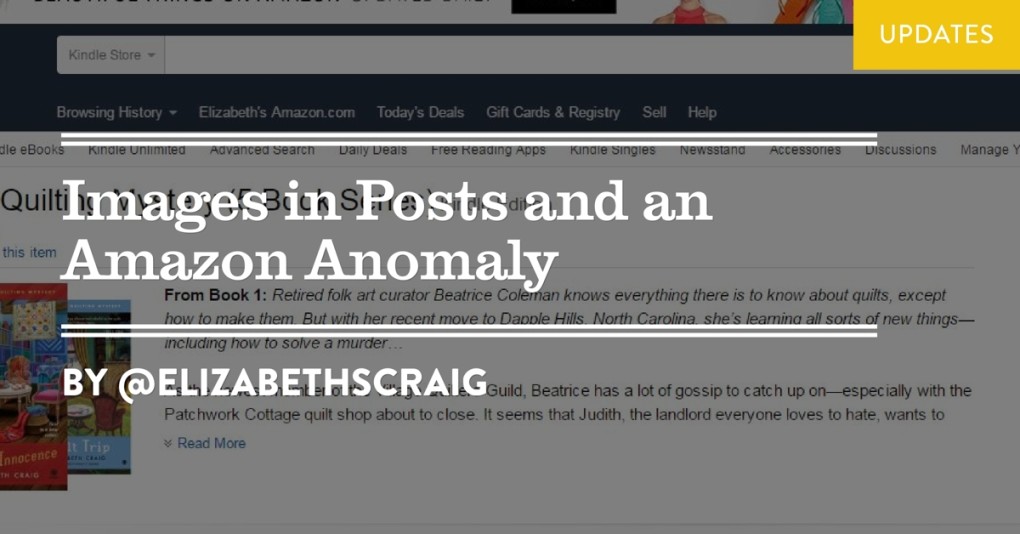
Second, an oddity with Amazon. Continue reading

Why Free is Still a Smart Marketing Strategy for Fiction Writers

facebook_e144c82042

by Jason Kong, @storyrally

If you’re wondering whether not charging for selected stories is benefiting your promotional campaign, you’re not alone.

With all the free writing flooding the internet, it’s harder to stand out. Even if someone downloads your free eBook, your fiction is competing with all the other stories on that person’s digital reader.

Given the ubiquity of free, it’s reasonable to question whether the market is saturated, thus reducing the effectiveness. I, on the other hand, believe free still works.

Let’s take a closer look on why that is.Continue reading

Twitterific Writing Links

Twitterific

by Elizabeth S. Craig, @elizabethscraig

A weekly roundup of the best writing links from around the web.

Twitterific writing links are fed into the Writer’s Knowledge Base search engine (developed by writer and software engineer Mike Fleming) which has over 30,000 free articles on writing related topics. It’s the search engine for writers.

How a writer wrote 29 stories in 29 days:  http://ow.ly/s4YX301dgNM @sophiegood @Write_Track

Crime Writers: Can a DNA Sample Reveal Age? http://ow.ly/xvGl300Q9M3 @DPLyleMD

Hook Your Reader: 3 Tips for Novelists:  http://ow.ly/hXpF300SzUg @womenonwriting @WriteToSell

Offline strategies for building your email list:  http://ow.ly/rH9T300SArL @cksymeContinue reading

Mysteries as a Reader and a Writer

facebook_9ae1e1fe72

by Elizabeth S. Craig, @elizabethscraig

What makes a solid mystery?   What is it about murder mysteries that draws readers to the genre? How good are mystery writers at picking out the killer as readers?

Today, I hope you’ll join me at Benjamin Thomas’s excellent blog, The Writing Train, where I discuss these questions and others…including why Scooby Doo could be counted as one of my major influences.   :)

Hope you have a great weekend.


Let’s Get Sensory: Powering Scenes Using The 5 Senses

by Angela Ackerman, @AngelaAckerman

There isn’t a writer alive who doesn’t believe description is important. We know that the key to pulling readers into our fictional world lies in how well we can describe each scene, giving it color and texture, and infusing it with emotion and substance. And one of the very best ways to achieve this is to use sensory detail: the sights, smells, tastes, textures, and sounds that our POV character or narrator experiences.

Emotion factors heavily in sensory description because the mindset of the POV character influences what they notice (which also determines what details the reader is privy to). A character sitting by a river to enjoy a happy, reflective moment after graduating university may be drawn to clusters of green shoots along the muddy bank that slant in the direction of the sun.  She might note the sharp, clean scent of pine needles and how each breath makes her feel renewed. The give of moss, the gentle breeze, and the sound of the water chuckling across stones…all of these details may lull her (and the reader) into a sleepy state of satisfied bliss.

However, a character dropping behind an uprooted tree along the riverbank to hide from her enemies would focus on different details: the poke and scrape of wood against her back and arms as she presses tight against the fan of roots. The cold river water seeping into her shoes as they sink in the mud which reeks of decay. The snap of branches, the shouts of her pursuers, the squeezing rush of her own shuddering breaths.Continue reading

Scroll to top