Your Novel’s Language: How Can You Beat the Blah?

Guest Post by Jack SmithWrite and Revise for Publication

You have an interesting and compelling premise for your novel.  Your logline is snappy and fetching.  Your characters are complex with complex relationships between them.  Your plot is lock-step, every thread tied up.  Your setting is interesting.

Yet the writing itself isn’t working—it seems drab.  A sample of ten to fifty pages will most likely not get past the agent or editor.  Great idea, but needs considerable work.  Give this thing some flair.

And so now is the time to do some major fine-tuning on the language itself.

What can you do?  There are probably fifty things, but consider two general areas:Continue reading

Twitterific Writing Links

by Elizabeth S. Craig, @elizabethscraigBlog

Twitterific links are fed into the Writer’s Knowledge Base search engine (developed by writer and software engineer Mike Fleming) which has over 23,000 free articles on writing related topics. It’s the search engine for writers.

Tropes: combine them for more originality:  http://ow.ly/AKmhp

Pitching Tips:  http://ow.ly/AKjDi @Eric_Haywood @scriptmag

‘Retail stonewalling’ and Amazon sightings in bookstores:  http://ow.ly/ASeoa @Porter_Anderson  @TheFutureBook

Why Creative Side Projects Are Good for You:  http://ow.ly/ASzNo @kevanlee

What Writers Can Learn from Illustrators:  http://ow.ly/ASAFO @stephens_helen   Continue reading

Keeping Our Books Current

by Elizabeth S. Craig, @elizabethscraigclip

My thirteen year old daughter uses an iPod device for most of her communications (which only works when on wi-fi) but also has a basic phone for when she’s away from wi-fi or needs to make calls. But she rarely uses the phone.

She discovered recently that she had voice mails on it.  But she was having a hard time accessing them.

Sadly, I was doing something else every single time she brought this up over a period of several days.  This is something I try hard to avoid as a parent.  My goal is to be 100% focused on my children as they are speaking with me.  But on these occasions I was either driving on an interstate highway in heavy traffic,  cooking something rather complicated, or doing some sort of multitasking (poorly, I’m sure) during these conversations.Continue reading

How to Use Backstory to Keep Readers Reading

by K.M. Weiland, @KMWeilandV8374c_JaneEyre.indd

Backstory is a weapon. And just like any weapon, it can end up doing more harm than good to those who wield it without proper experience and care. But in the hands of a writer who knows exactly what it’s capable of and how to wield it to advantage, backstory can take even ordinary stories to extraordinary places.

Arguably, the most important function of backstory is its ability to hook readers’ curiosity. Forget explaining the protagonist’s past and what motivates him. Try not explaining it. When we let readers know there’s something delicious and dark in a character’s past, without telling them what that something is, we’ll hook their curiosity so deeply they’ll keep reading just to solve the mystery.

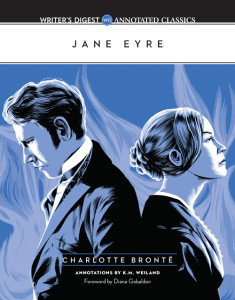
Charlotte Brontë understood how to wield the weapon of backstory as well any author. In her beloved Gothic romance Jane Eyre (which I analyze in-depth in my book Jane Eyre: The Writer’s Digest Annotated Classic), she creates almost her entire plot out of the tantalizing hunt for the backstory. What can you learn from her and how can you apply it to your own novel? Start by answering the following questions.Continue reading

Twitterific Writing Links

by Elizabeth S. Craig, @elizabethscraigBlog

Twitterific links are fed into the Writer’s Knowledge Base search engine (developed by writer and software engineer Mike Fleming) which has over 23,000 free articles on writing related topics. It’s the search engine for writers.

Screenwriting Lessons: ‘The Social Network’: Handling Exposition: http://ow.ly/ApZcW @gointothestory

Don’t forget your name. That’s what sells books.  http://ow.ly/ApZLL @venturegalleries

5 Things Learned While Writing a Novella:  http://ow.ly/Aq009  @YAMisfits

Scare Quotes Are Not All That Scary:  http://ow.ly/Aq02e @CSLakin

Uses for Helping Verbs: http://ow.ly/ApZoN @writing_tips               Continue reading

Scroll to top