Use Attitude When Introducing Characters

by Jodie Renner, editor and author  @JodieRennerEdCaptivate Your Readers_full
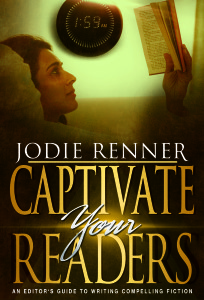
To celebrate the release of her third writing guide, Captivate Your Readers, Jodie has priced it at 99 cents for today only and will also be giving away 4 electronic copies – your choice of mobi (for Kindle), ePub (for other e-readers), or PDF – of this book, in exchange for an honest review by the end of March. Enter to win in the comments below.

A sure sign of a fiction writer who’s still learning his/her craft is when a character comes on the scene for the first time and the writer stops the story to describe the character from head to toe – height, build, hair color, eyes, other facial features, and all the details of their clothing, including colors, down to their shoes. Then the story picks up where it left off and carries on.

My latest writing guide, Captivate Your Readers, devotes four chapters to how to introduce and describe characters in a natural, intriguing way. The basic message is to stay in the protagonist’s viewpoint when introducing him, and describe other characters through the POV of the character observing them, not neutrally, as the author stepping in. Here, I’ll be discussing effective techniques for describing other characters through the observations and attitudes of the viewpoint character (most often the protagonist).Continue reading


Twitterific Writing Links

by Elizabeth S. Craig, @elizabethscraig

Blog

Twitterific writing links are fed into the Writer’s Knowledge Base search engine (developed by writer and software engineer Mike Fleming) which has over 30,000 free articles on writing related topics. It’s the search engine for writers.

Agent @Janet_Reid on strategy for a second book:  http://ow.ly/JrwhL

The Art of ARC-ing:  http://ow.ly/JrsOs @MarcyKate

Calendars, Timelines, and Collages: Mapping the Imaginary:  http://ow.ly/JrwhM from Hannah Gerson @The_Millions

8 Tips From Literary Agents About How to Get Published:  http://ow.ly/JrteH @monicamclark

Mobile Marketing Just for Authors:  http://ow.ly/JL4g4  @CaballoFrances

Continue reading

The Impact of Free Promos

By Elizabeth S. Craig, @elizabethscraigDeath to the Stock Photo Book Sale

I had to answer a questionnaire for self-publishers recently and several of the questions stumped me.  I have a feeling that this isn’t a good thing.

One of the questions was ‘How many books have you sold (not given away)?’  I had absolutely no idea.  And this information is not exactly as easy to come by as you might think.  There is no way on your KDP dashboard to find lifetime sales.

I also had no idea how many books, total, I’d given away.

Another question was ‘What is your strongest selling title?  How many units have you sold?’

Hmm.

In my defense…I have been very busy writing several series.  My self-published books number six which, although not a huge number, certainly adds a bunch of lines and some complexity to each month’s KDP excel sheet.Continue reading

Randomizing Revision

by Leslie Budewitz, @LeslieBudewitz Assault and Pepper (Final)

I take a methodical approach to revision. As I work on the draft, I start a list of “Revision Notes”—facts to check, inconsistencies to iron out, name changes to clean up. When the draft is complete I print it out and punch it into a fat, three-ring binder. I make an outline, adding to the Revision Notes as I go, with some comments organized by chapter and some by topic. (“Jen or Jenn?;” “Deepen Pepper’s doubts about investigating;” “Kristen lecture Pepper about getting involved with Tag twice? Earlier is better.”)

Then I start the read-throughs, which I sometimes call drafts even though I’m working from the same physical copy. Each read-through involves a different layer of the ms. In the plot draft, I fix the holes I’ve identified in the outline and others that jump out at me as I work. In the character draft, I make sure the protagonist drives the action (I write in first person) and that every secondary character pops. In the scene draft, I sharpen the goals, motivation, and conflicts, and make each transition clear, so the reader never wonders about time or place. I look to make sure I’ve kept it cozy, that I’ve never lost track of the dog, and that I’ve given my protagonist all the trouble she can handle—and then some.Continue reading

Scroll to top