“Couponing” for Authors—Guest Post by J.L. Greger

by J.L. Greger
Coming Flu Front CV“Couponing” for Authors

Every shopper likes a good deal; every writer likes a clever idea. Most of us see lots of great ideas, but forget most of them. That’s why I “coupon” them.

Is “couponing” a real word?
One definition (found on The Free Dictionary) is the sending out or turning in coupons. That’s not the meaning I want to focus on today. I want to target all the “guides to couponing” found on the WEB and in popular women’s magazines.


Couponing ideas for writing:

I substituted the word ideas for coupons in a composite guide for couponing. My examples will focus on the development of my two novels Coming Flu, a medical thriller published by Oak Tree Press in July 2012, and Murder: A New Way to Lose Weight, a medical mystery to be published in April 2013. They are the start of a medical mystery series set in the Southwest.

Look for ideas everywhere. Printed materials, TV, ads, etc.
I like to include bits of science in my novels to add authenticity. So when I read Science and other scientific journals weekly, I pull pages that look interesting. I save maps and postcards (with notes) when I travel. Now for the hard part.

Identify a use for ideas.
Write on each saved item an anticipated use when you clip it.
For example in April 2010, I read an article “The Microbes Made Me Eat It” (Science 328: 179-180) and labeled it, in my messy scrawl, “novel on obesity.”

Focus your collection activities.
Random collections are difficult to use and bulky to store. That’s one problem with computers, most of us save too much unsorted (or poorly sorted) fluff.
 
Throughout 2010, I looked for and found interesting articles in medical journals on how the trillion microorganisms in our guts influence us, including our weight control or lack of it. The result was Dr. Izzy Roth and Dr. Richard Varegos, the diet doctors in Murder: A New Way to Lose Weight. Of course, Izzy is killed in the first chapter of this medical mystery and Richard is suspected.

Keep a file of quotes.
Ads and students comments in classes often provide the best quotes.
Currently I’m trying to create a character to be described by this quote from Oscar Wilde. “Some cause happiness wherever they go; others, whenever they go.”

Don’t save stuff that is easily available on the Web.
To emphasize how difficult it is to lose weight, I set many scenes in Murder: A New Way to Lose Weight in popular restaurants in the Albuquerque area. I used the menus published on the web to give descriptions of food.

File ideas the day you get them.
This is a good idea, but I can’t give an example because I’m not that organized.

Review ideas regularly and purge.
In 2006, I started saving articles on mutations in the flu virus, the development of vaccines, epidemics, and the Model State Emergency Health Powers Act with the intent of using them in a novel. Re-examining the file when it was a half-inch thick finally gave me the incentive to start writing Coming Flu. Yes, I did use this information to create a realistic (certainly not optimal, but not a worst case scenario either) of what could happen if a new and deadly mutation of the flu virus hit a community before vaccines to the new virus were available.

Are you ready now to start couponing your ideas?
 
JanetAndBug
JL Greger was a faculty member in the biological sciences for more than for 25 years at the University of Wisconsin-Madison. She also served as the associate dean in the graduate and medical medical school at UW and as VP of Research at the University of Connecticut. Now she enjoys putting tidbits of science into her fiction. She hopes her novels help to increase interest by women and minorities in careers in science.
 
Coming Flu (paperback and ebook versions) is available now on Amazon.
Look for Murder: A New Way to Lose Weight in March 2013.

The Evolving Published Story

by Elizabeth S. Craig, @elizabethscraig
file0001546045843I read a Salon post by Joseph Lord— “Walking Dead” author is OK with AMC’s creative liberties“–  on Sunday that struck a particular chord with me.

The article was about Walking Dead creator,  Robert Kirkman’s, thoughts on AMC’s plot changes and character changes for the series (Walking Dead started out as a graphic novel.)  Basically, as the post’s title indicates, Kirkman was fine with it. 

But what I was especially interested in was this statement from Salon writer Joseph Lord:

…he doesn’t mind the implicit criticism — and revels in the opportunity to revisit, re-craft and re-create five-year-old writing.

The article goes on to explain that Kirkman is creatively involved with the television show, which means he’s helping craft the changes.

What I found most thought-provoking was the attitude behind this statement—that creative fulfillment can be found by tinkering with a completed, published story.

Now, the reason Kirkman’s story is changing is primarily because it’s going from one medium to another.  But I’ve also noticed this post-production editing phenomenon with the sudden popularity of ebooks.  Even with some of my stories.

No matter what you might hear about traditional publishing’s superior editing process—mistakes still happen.  I hate to admit that.  I didn’t catch them, even though I read the manuscripts until I was cross-eyed. My editor didn’t catch them and Penguin’s proofreader didn’t, either. I’ve made small mistakes in, I believe, nearly every single one of my books.  Not big mistakes—but hey…they’re all big mistakes if readers contact you over them. 

And readers do contact you.  They don’t look at the acknowledgments page and find the editor’s name and send her an email.  Which is fine—it’s my book.  I’m the public face for the book. 

I’ve heard about a variety of different flubs on my part with my Penguin books.  Each time I apologized to the reader who drew it to my attention, explaining that the last thing I wanted was to draw her out of the story.  And…that was basically it.  When the reader asked if the book could be corrected, I said if I was told it was going into another printing, I’d ask my editor to see if it could be corrected.  As far as the ebooks…I’ve never heard it suggested that Penguin will correct those after the fact.

On the other hand…I’ve also heard about a couple of minor errors (still…errors…grr) in my Myrtle Clover self-published mysteries.  You won’t find those errors—I removed them myself and republished the books.  Again, I apologized to the readers who drew my mistakes to my attention.  But this time, I had the real pleasure of telling them that I would correct the errors.  And that was a pleasure.  There’s nothing like fixing a problem. 

That’s a big difference right there between traditional and self-published. 

But, aside from proofreading….what might evolving books mean for the future?

I have some mixed feelings about changing books, post-publication.  I’ve read posts where writers argue for story integrity—the story is the story.   I understand where they’re coming from.

What if our story is a bit outdated?  What if we mention Facebook in our ebook and Facebook goes under (oh happy day!)?   Should we go back into our story and remove the reference and republish?  Or will this destroy historical texture in our books?  Okay, maybe we won’t do that with a Facebook reference.  But what if our backlist book referred to the Twin Towers and we were republishing it as an ebook?   Would we update those types of references, given the opportunity? What if Dickens and his descendants had updated his story all the way to the present day? 

Of course, nonfiction might acutally benefit from this approach.  Imagine creating a resource that doesn’t become obsolete or outdated.

On the pro side—I don’t think I’m the only one who has ever reread an old book I wrote and wanted to make changes.  A better word, a better bit of dialogue.  A stronger verb.  Who’d even notice the difference?

On the con side–there is such a thing as over-writing. I know I used to write the life out of my story and the personality out of my characters by scrubbing relentlessly at my manuscript over and over again…when it was really fine to begin with.

What about reader preference?  What if an author read complaints about the sagging middle of his published book—then he had a fantastic idea about changing it?   Should the readers influence the book’s text?

Maybe the above example was a weak one…because I think many authors would want to fix a weak scene or two if they knew how to.  What if it were a more controversial change?  What if a writer received complaints about the profanity in his books?  Should readers get a vote on that?  What if it were fifteen readers complaining?  What if it were a hundred?  Would that change our answer?  How much input should readers have?  How responsive should future authors be and what’s our responsibility to our readers, ourselves, and our story?

One other point…we do need to get on with writing our next book, don’t we?  To establish a name for ourselves, income, and a career.  It’s probably not in our own best interests to stay stuck on the same books…after a certain point, anyway.

Or—can we/should we, as the article stated—“revel in the opportunity to revisit, re-craft and re-create”? 

How much messing with a book is too much?  And y’all…I don’t have an answer for this, so I was hoping you could weigh in. Maybe our responsibility is to the reader to provide the most perfect entertainment we can and to capitulate to their requests. Maybe that’s outrageous for a finished book.  Maybe our responsibility is to the story itself.  But…I know that when I’ve gone into my self-pubbed books to make my proofreading corrections, I couldn’t resist tinkering with other stuff, too.  Where does it stop? 
 
Image: MorgueFile: jdurham

Trust In Your Ability To Tell A Story

by Elizabeth S. Craig, @elizabethscraig
Christmas Cactus
This post has spoilers for Beth Spann. (I’ve already texted Mama and asked her not to read my Monday post—Mama, if you are reading the post, this is your spoiler alert!)

I was at a garden center last week, looking for a Christmas cactus to give my mother for Christmas.

There was a really pretty plant there—it’s in the picture, above.  It was obviously the best choice for a gift.

While I was looking around, the owner of the garden center bustled around, answering questions and sounding extremely knowledgeable about plants. But by the time I’d make it to the register, she’d disappeared to a different area of the nursery.  There was another lady at the register who smiled at me.  “Can I help you?” she asked.

“I don’t have much luck with indoor plants,” I said.  “I need to make sure this plant makes it until Christmas.  Do you have any tips for me?”

The woman looked at me with wide eyes.  “Let me see if I can find Sara real quick.”

She did her best to find Sara, but she was nowhere around.  The woman returned slowly to the register.  “I’m afraid she’s not around.”

“Do you know how much water it needs?” I asked. “I usually have problems with watering.”  There wasn’t one of those little plastic stakes that usually tells how to care for the plant, either.

The woman took a deep breath, seemed to do a mental search of all her knowledge on cacti, and said, “Well….the soil should be moist, but not wet to the touch.  You need to keep it out of direct sunlight and make sure it’s not under any heat vents.”  She continued talking about the plant, getting more confident as she went and giving me more and more information about Christmas cacti.

I thanked her for her help, and then said, “You seem to know a lot about the plants.”

“Oh, I take care of them,” she answered.

So…she took care of the Christmas cacti every day, but didn’t seem to trust herself to explain to me how to care for them.  She wanted to find the expert—the owner.

This is the way I think many of us feel when we’re writing, too.  We don’t trust ourselves to tell the story.  We hesitate as we’re writing, thinking we can’t tell the story the way we want it to be told.
 
We read up on the writing craft, but sometimes this reading takes the place of our practice time.  There’s definitely a point where we need to put our how-to books aside and just write our story. 

Like the lady who took care of the plants—when we practice, we learn.  And once we finish our first draft, we have ample opportunity to edit our story to ensure it’s exactly the one we meant to tell.

A few tips for making sure we finish our story:

Set a manageable goal.  Revisit that goal if it proves not to be manageable.

Show up.  Meet that manageable goal we set for ourselves by sitting down and opening up our document.

Be flexible with our writing time and the places we write.  Be open to writing on the spur of the moment.

Read books in our genre. It’s the only way to learn how to structure books, or to get a sense of the right pace for our stories.  Read blog posts, books, and articles that help us improve—but don’t let the how-to reading interfere with or take the place of our writing time.

Be forgiving of our first draft.

Stop comparing ourselves to others.  Enjoy others’ work, learn from it.  But develop our own voice and confidence in our writing…by writing regularly.

Do you trust yourself to tell your story?  How do you work through your insecurities to finish your draft?  Tips for staying motivated?

Twitterific

by Elizabeth S. Craig, @elizabethscraig

Twitterific
is a compilation of all the writing links I shared the previous week.

The links are fed into the Writer’sKnowledge Base
search engine (developed by writer and software engineer Mike Fleming) which
has over 19,000 free articles on writing-related topics.  It’s the search engine for writers.

Sign
up for our free newsletter for monthly writing tips and interviews with top
contributors to the WKB or like us on Facebook.


Try “My WKB”–a way for you to list and sort articles,
view your read articles, and see your search history. Read more about it here:
http://bit.ly/S9thqS.
The free My WKB page is here:
http://bit.ly/PV8Ueb. And check out Hiveword to
help you organize your story.

 
3 Stages of Merger Reaction: http://bit.ly/TljUDw
@Porter_Anderson @eoinpurcell


Ex-pat characters in crime fiction: http://bit.ly/Tn5DCB
@mkinberg


Tips for effective action scenes: http://bit.ly/TohArF
@JodieRennerEd


Tips for developing your writing style: http://bit.ly/X3Jtvg
@aguiltymind


The Essence of Genre–At The Movies: http://bit.ly/X3WDZn
@camillelaguire


Is There
Ever a Time to Give Up On that Book?
http://bit.ly/TNTiX5
@AimeeLSalter

 
Why is an ebook ever riddled
with typos?
http://vrge.co/TNTkxZ
@laura_june

Defining genre: http://bit.ly/TNTohq @noveleditor

After e-literature, there’s no
going back:
http://bit.ly/S7ZCwi @salon

Do publishers hate authors? http://bit.ly/Wp8goI
@VictoriaStrauss @Business_Ghost @petermccarthy @Porter_Anderson


Refresher on semicolons: http://bit.ly/TNTxkS

How Dialogue Reveals Character:
http://bit.ly/S7ZNb7 @maria_mckenzie

Romance reader stats from RWA: http://bit.ly/S8051u

The search engine for writers: http://hiveword.com/wkb/search

iBook­store in 50 Coun­tries: A Step-by-Step List­ing
Guide:
http://bit.ly/QuqeJH @lizcastro @Porter_Anderson


How to speak publisher: F is
for Flat fee:
http://bit.ly/TOofu7
@anne_rooney

5 Tactics Bloggers Can Steal
from Fiction Writers:
http://bit.ly/S8IhU7
@originalimpulse

5 tips for new writers: http://bit.ly/TOowNB @sierragodfrey

Who Dictates What You Write? http://bit.ly/S8IzKG @write_practice

3 Keys to Storytelling: http://bit.ly/TOoFAM @KristanHoffman

Openings that Orient: http://bit.ly/S8ICWX @fictionnotes

Balancing the Scenes that Make
Up Your Novel:
http://bit.ly/TOoJjW
@kristenlambtx

What Does a Character Look
LIke? Are You Sure?
http://bit.ly/TOoMw1

9 Ways to Beat Writer’s Block: http://bit.ly/TOoR2N+|+Duolit%29&utm_content=Google+Reader
@WrenDoloro

How (Not) to Be an Awesome
Critique Partner:
http://bit.ly/S8INBx
@ava_jae

Things Silent Movies Can Teach
us About Storytelling:
http://bit.ly/TOoYLU
@janice_hardy

How to Save a Bundle on Editing
Costs:
http://bit.ly/S8J2wm @JodieRennerEd

All about publishing auctions: http://bit.ly/S8J7A4 @sjaejones

Is Traditional Publishing a
Happily Ever After?
http://bit.ly/S8JeM1
@LauraHoward78

How to Perfect Your Elevator
Pitch & The Low-Down on Agency Assistant Salaries:
http://bit.ly/QX2HRw @breeogden

How To Maintain Steady Book
Sales at Amazon and Barnes & Noble:
http://bit.ly/10q5y6g
@goblinwriter

Help readers keep characters
straight:
http://bit.ly/QX36U5 @juliettewade

The Subconscious Storyteller: http://bit.ly/10q6t6L @mooderino

How To Make Google Love Your
Blog:
http://bit.ly/QX3qCh @woodwardkaren

Does Facebook Work For Authors?
http://bit.ly/10q7fR8 @mollygreene

Using Conflicts And Setbacks To
Create Narrative Drive:
http://bit.ly/XikQvT
@woodwardkaren

iBook­store in 50 Coun­tries: A
Step-by-Step List­ing Guide:
http://bit.ly/QuqeJH
@lizcastro @Porter_Anderson

Tips for writing humor: http://bit.ly/UNPjLk @joebunting

8 red flag rules for writers: http://bit.ly/WmHEJC @krissybrady

The Search Engine for Writers: http://hiveword.com/wkb/search

“Songwriters on
Songwriting”: Pete Seeger:
http://bit.ly/Qv32Ld
@gointothestory

What Writers & Publishers
Need To Know About deviantART:
http://bit.ly/Qv371x
@galleycat

Are Self-Publishing Authors
Killing the Publishing Industry?
http://bit.ly/WkcdL7
@passivevoiceblg

Popular Marketing Mistakes:
Cannibalism:
http://bit.ly/YatzQ2

13 Ways to Find New Readers for
Your Books:
http://bit.ly/TgHYnV
@BookMarketer

How To Get Your Book Reviewed: http://bit.ly/TgIbY5 @bookmarketer

Why Indie Authors Should Have A
Facebook Interest List:
http://bit.ly/YaubFj

The importance of genre zines: http://bit.ly/YauxMf

How To Record Your Own
Audiobook: Setting Up A Home Studio:
http://bit.ly/Yaxb4E
@woodwardkaren

After “The End” – The
Epilogue:
http://bit.ly/TgK8DS @THahnBurkett

Why and how to blog a book: http://bit.ly/Yaxw7h @ninaamir

The bookstore brain: http://nyr.kr/TgKgDv @pageturner

Synopsis writing tips: http://bit.ly/YaxLze @lynnettelabelle

Copyright for titles and ideas?
http://bit.ly/Yay3WO @behlerpublish

How authors write: http://bit.ly/TgKOJr @jason_pontin

10 Vonnegut-Centric Sites: http://bit.ly/Yayr7Q @deadwhiteguys

People vs. persons: http://bit.ly/TgKXws @writing_tips

“Whatever you have to do
to finish it, finish it”:
http://bit.ly/YayEYv
@gointothestory

Can sci-fi be a happy place? http://bit.ly/TgLcHV

How to Realize Your Dreams Even
If You Don’t Know How to Get There:
http://bit.ly/Yaz69k
@JWhite

Publisher: a new role in data
herding:
http://oreil.ly/TgLqiq @JennWebb

Soft-boiled vs hard-boiled
mysteries:
http://bit.ly/YazqVu
@SouthrnWritrMag

Semicolons: A Love Story: http://nyti.ms/TgLVce @nytimes

How To Buy Your Author Domain
Name:
http://bit.ly/YaA8lz @authormedia

You may want to stop pursuing
publication if…:
http://bit.ly/TgNMOd
@rachellegardner

Have We Already Reached
“Peak E-book?”:
http://bit.ly/YaCLnx
@pubperspectives

21 Unexpected Places To Find
Your Writer’s Muse:
http://bit.ly/TgNUNF

How to Get Your Book Noticed in
Today’s Changing Marketplace:
http://bit.ly/YaCReO
@StinaLL

Tips for handling publishing’s
waiting game:
http://bit.ly/TgO2N7 @aswinn

How To Get Honest Book Reviews:
http://bit.ly/TgOb3b @woodwardkaren

How to Attract Customers With
Pinterest:
http://bit.ly/TgPfUL @smexaminer

12 Days of Book Sales: A Dozen
Holiday Book Promotion Ideas:
http://bit.ly/TgPn6M
@duolit

Top 10 Wolves in Fantasy: http://bit.ly/YaJ8az @dk_stevens

Tips for your endings: http://bit.ly/YaJePd @livewritethrive

Characters–5 defining
characteristics of Alarm personalities:
http://bit.ly/TgRYO6
@jeanniecampbell

Using an “Otherworld”
as inspiration for our writing:
http://bit.ly/YaJvSq
@GeneLempp

Romance–examples of books
where friends fall in love:
http://bit.ly/TgSfAq
@MirandaKennealy

50 Ultimate Genre Match-Ups: http://bit.ly/YaK7HI

Screenwriting–Planning Action
Sequences:
http://bit.ly/TgSBHp
@gointothestory

How To Build Your Business And
Your Blog:
http://bit.ly/YaKtOl
@thecreativepenn

Adaptation is Translation: http://bit.ly/TgSGLb @amazonbooks

15 Idioms for Periods of Time: http://bit.ly/YaKF0b @writing_tips

4 Writing Fears, Debunked: http://bit.ly/10sIJ2L @ava_jae

13 Ways to Know You Have the
Right Idea For Your Book:
http://bit.ly/TgZKYi
@writersdigest

Romance writing–5 Fictional
Small Towns with a Difference:
http://bit.ly/10sJ0md
@Janga724

How to Write Dialogue Unique to
Your Characters:
http://bit.ly/TgZWXt
@marcykennedy

No Reader Left Behind: http://bit.ly/10sJmta @kristinerusch

Striving to Be a Better Writer
by Writing More:
http://bit.ly/Th00X1
@KarenCV

An Agent On Using Flashbacks in
Writing:
http://bit.ly/10sJIjw @kid_lit

8 Ways Authors Turn Off
Potential Readers:
http://bit.ly/Th0ble
@novelrocket @cerebralgrump

Should Authors Stalk Review
Sites?
http://bit.ly/10sKblL @jodyhedlund

Add a Pinch–or a Pound–of
Poetry to Your Prose:
http://bit.ly/Th0kFb
@janice_hardy

Remember to celebrate your
successes:
http://bit.ly/10sKA7K

Does Amazon KDP Select Drive
Away True Fans?
http://bit.ly/Th0r3J
@woodwardkaren

A beat sheet for romance
writers:
http://bit.ly/10sL0en @jamigold

Beware of Simon & Schuster’s Archway Pub.: http://bit.ly/X4Ne3N
@Porter_Anderson @VictoriaStrauss

 
Scholarly writing: Open Access
— What Do Authors Really Want?
http://bit.ly/Th0ywh
@scholarlykitchn

A refresher on hyphens: http://bit.ly/10sM2Xw @writing_tips

How to Write Scary: http://bit.ly/Th125w @4YALit

Choosing A Theme for Your
Author Blog:
http://bit.ly/10sMG7F

Script To Screen: “The
Rocky Horror Picture Show”:
http://bit.ly/Th16lC
@gointothestory

Richard Burton and the Writing
Process:
http://bit.ly/10sMPYv

Are You Skimming Your Story’s
Potential?
http://bit.ly/Th1bWu @KMWeiland

Criminal behavior info for
crime writers:
http://bit.ly/10sN7yH
@KarenCV

5 WordPress Plugins for
Increased Writing Productivity:
http://bit.ly/S1ZQ6W
@lifehackorg

Swearing in YA Fiction –
Authentic? Or Gratuitous?
http://bit.ly/Tl2ua1
@AimeeLSalter

Idea-Stealing: How Not to Let
Your Fear Stifle Your Creativity:
http://bit.ly/S1ZZr7
@diymfa

10 things editors look for in
non-fiction:
http://bit.ly/Tl2E1g
@rachellegardner

World Building & Story
Creation: Use What You Know:
http://bit.ly/Tl2Hdq
@woodwardkaren

Timing your book’s launch date
for maximum impact:
http://bit.ly/S20ame

7 Narrative Writing Tips: http://bit.ly/Tl2QO1 @thewritermama

Websites for Indie Authors: http://bit.ly/S20jGj

Writers’ most common submission
mistakes — and how to avoid them:
http://bit.ly/Tl2VBk
@MidgeRaymond

3 Ways to Grow Your Author
Newsletter:
http://bit.ly/S20npy
@authormedia

How to Motivate Yourself to
Actually Achieve Your Goals:
http://bit.ly/Tl33Ri
@lifehacker

Why do agents ask for only a
few chapters?
http://bit.ly/S20wsW
@mooderino

If Self-Publishing Books Is SO
Easy, Why Do Self-Pubbers Work So Hard At It?
http://bit.ly/Tl3c7g
@badredheadmedia

The Business of Screenwriting:
Low-budget filmmaking:
http://bit.ly/S20DVz
@gointothestory

Empathy. It’s Where Characters
Are Born:
http://bit.ly/S21jtV
@DanceOfRomance

How To Write When You Don’t
Have The Time:
http://bit.ly/Tl3NFU
@booklifenow

Are writers too insulated from
their readers?
http://bit.ly/Tl3Phb
@CerebralGrump

A Successful Author Builds a
Team:
http://bit.ly/103yQHy @danblank

When you hit the brick wall
while writing your story:
http://bit.ly/TOtBYG
@YAOTLBlog

Don’t sabotage your writing
career:
http://bit.ly/XinKAY
@jameswatkinscom

3 things your editor needs to
know:
http://bit.ly/TOsDvn @wherewriterswin

10 Indisputable Signs That
You’re a Writer:
http://bit.ly/103wBE1
@ava_jae

Beware The False Compliments
That Are Killing Your Writing:
http://bit.ly/XilZnd
@fuelyourwriting

How to Win in Amazon’s KDP
Select Program:
http://bit.ly/XilxFI
@tweetthebook

How To Attribute Artwork
Licensed Under The Creative Commons:
http://bit.ly/ZMXX2d
@woodwardkaren

Do publishers hate authors? http://bit.ly/Wp8goI @VictoriaStrauss
@Business_Ghost @petermccarthy @Porter_Anderson

3 Stages of Merger Reaction: http://bit.ly/TljUDw @Porter_Anderson
@eoinpurcell

Revealing Your Novel’s Theme: http://bit.ly/S64lxi

Why today’s writers need a garret: http://bit.ly/X4zaHp
@Porter_Anderson @edcyzewski


Guide to Book Launch and
Advance Sales Strategies with CreateSpace and Lulu:
http://bit.ly/RbGIGE @jfbookman

Showing emotions instead of
telling them:
http://bit.ly/RbGRd0
@novelrocket

Do You Admit To Being A Writer
In Public?
http://bit.ly/S656qg
@thecreativepenn

Establishing a Writing
Schedule:
http://bit.ly/S65sgw @MaryKnapke

The journey to publication can
feel like a storm:
http://bit.ly/S65HIr
@lydia_sharp

Character Emotion: Is It
Written All Over Their Face?
http://bit.ly/RbHq6E
@angelaackerman

A Better Way to Engage Your
Readers: Go Responsive:
http://bit.ly/S66klc
@nickthacker

5 Ways to Make Google Calendar
Work For You:
http://bit.ly/ToLAr2
@lifehackorg

Freelancers: 8 Rules You’ll
Need to Become An Editor’s Go-To Writer:
http://bit.ly/ULZ3HQ
@problogger

Writing To Music: Knowing Your
Characters:
http://bit.ly/ToLPCq
@woodwardkaren

How libraries buy mysteries: http://bit.ly/ULZC4i

Your Must-Have Book Checklist:
From Idea to Publication:
http://bit.ly/ToM3cX
@KMWeiland

Tips for writing disasters: http://bit.ly/UM0iqv @Dianapfrancis

5 Ways To Get Your First Draft
Material Out Of Your Head And Onto The Page:
http://bit.ly/ToMgNb
@thecreativepenn

Scriptwriting–Great Scene:
“American Beauty”:
http://bit.ly/UM1eep
@gointothestory

Backlists:Authors Discover the 1978 Copyright Act: http://bit.ly/TnYi61
@jeffjohnroberts @Porter_Anderson


Why Are We Running as Fast as
We Can to Stay in the Same Place?
http://bit.ly/UM1B8F
@annerallen

Sound Effects In Your Writing: http://bit.ly/ToPal1

Using book structure to create compelling stories: http://bit.ly/V9Urve
@suspense_writer


The importance of moments of normalcy to crime fiction: http://bit.ly/RnPC3V
@mkinberg
 
Amazon Doubles Down on Exclusivity: http://bit.ly/RoRYPT
@MarkCoker

Using Book Structure to Create Compelling Stories–Guest Post by Terry Ambrose

 by Terry Ambrose, @suspense_writer
Purchase here
The
epiphany, the “aha” moment, the smack on the side of the head. No matter what
we call it, that moment when the last piece of the puzzle snaps into place is
an amazing moment. In this case, that moment had to do with writing a
compelling story.

Let’s face it, some writers are just masters at
creating a story that readers can’t put down. For me, that’s the ultimate
compliment and the holy grail of writing mysteries and suspense. I’ve studied
and practiced the craft of writing for many years and became a fan of Jack M.
Bickham’s scene and sequel writing theory for some time back. In my opinion,
most fiction writers would benefit just by learning Bickham’s theories about
how to structure a novel.

Scenes and
sequels

When I read Bickham’s “Elements of Fiction
Writing: Scene and Structure,” I realized that my writing had subconsciously
been moving in that direction for years. Bickham’s guidance was what I needed
at precisely the right moment. It gave me questions to ask before I started
laboring over any new scene. In short, it gave my writing structure.

        
Everything
that happens in a story is based on a stimulus and for every stimulus, there
will be a character response.

        
Scenes
advance the story through establishing character goals, generating conflict,
and taking characters one step forward, two steps back with major and minor
disasters.

        
Sequels
provide the reader an opportunity to get closer to the characters by showing
why they took an action and what emotions they felt. The sequel also sets up
the next action in the story.

The “next”
paragraph, from structure to compelling

My second “aha” moment was pure serendipity. I’d
just attended a meeting where bestselling author Kelley Armstrong talked about
plotting. She gave a number of tips to help writers move their plots forward
more quickly. That, as the saying goes, “primed the pump.” The real smack on
the side of the head came when my wife brought home an old Greg Isles book that
she came across while working at the Friends of the Library bookstore.

“Black Cross” hooked me with the first sentence.
So far, good job Mr. Isles, you made me want to finish the paragraph. At the
end of the first paragraph, I had to read the second. Then the third. By the
end of the second page, there was no question that this was what a compelling
read was all about—the next paragraph. The epiphany—it’s all about playing
dirty.

Playing
dirty

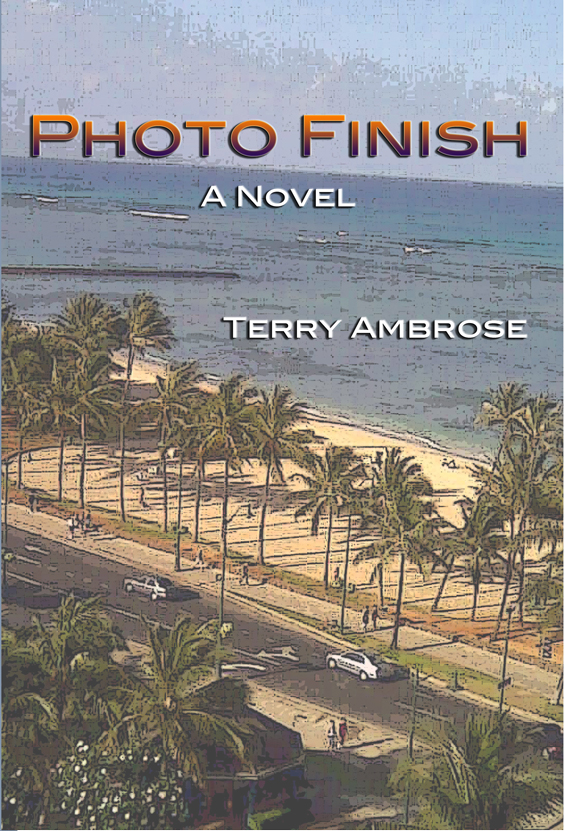
Whether I’m writing a funny Hawaiian mystery
like PHOTO FINISH or a suspense novel like my upcoming release, my goal is to
get the reader to the next paragraph. If I write each paragraph with a
mini-hook at the end, I’ll have done my part. Perhaps someday I’ll have another
moment like “the next paragraph” moment. Will it be days? Months? Years? I have
no idea. What I do know is that instead of using a hook at the end of each
chapter, as I did before, I’m now taking that concept to the paragraph level
and treating each paragraph as though it might be a chance for the reader to
put down the book. Sorry, readers, but I’m determined to play dirty and not give
you that chance.

About the
author

Terry Ambrose started out skip tracing and
collecting money from deadbeats and quickly learned that liars come from all
walks of life. He never actually stole a car, but sometimes hired big guys with
tow trucks and a penchant for working in the dark when “negotiations” failed.

In his debut novel PHOTO FINISH, a former skip
tracer meets a beautiful con artist in Honolulu and finds trouble almost too
hot to handle. Terry’s next novel, LICENSE TO LIE, will be released in mid
December. It’s about a $5 million con gone bad and the harshest lesson of
all—never trust a soul…even your own.

Learn more about Terry on his website at terryambrose.com
or on his Facebook author page at facebook.com/suspense.writer.

Scroll to top