Book Marketing Is Also Murder

 by Phyllis Zimbler Miller, @ZimblerMiller

Yes, as self-published and traditionally
published authors learn sooner or later, writing a mystery is only part of the
journey.  Marketing that mystery can be a
much more difficult and time-consuming part of a published author’s existence.
And that marketing can be murder – on
your psyche, your time and your wallet.
Why? 
Because there are so many online promotional opportunities today that
enable authors to stay in front of their computers and promote their
books.  But where to invest one’s efforts
and money (leaving some time to write mysteries, of course!) to get the most
bang for your buck?
The answer is probably different for each
author depending on a book’s genre, theme, etc. 
For example, if you love Twitter and do not love Facebook (me), then you
may not want to devote tons of your limited promotional time to Facebook.  Another author who loves Facebook and does
not love Twitter would not want to spend tons of time on Twitter.
What I find most perplexing is the
opportunities missed by authors on the elephant in the room – Amazon.  On many book pages on Amazon the cover and
title do not convey what the book is about. 
Nor do the cover and title appeal to the target audience.
Recently I realized that I was somewhat
guilty of this error myself.   I have
been adding or revising subtitles of my fiction books to better “signal” the
story.
We all know that people glance very
quickly at information online before deciding whether they are interested in
learning more.  If your book cover says
“for adults” and your story is “for children,” then you have a major disconnect
in what you are portraying.
Authors need to evaluate all their book
covers from their audience’s perspective. 
This realization led to my changing the
cover of my spy thriller CIA FALL GUY. 
As someone who many years ago had a security clearance, I thought the
manila envelope on the cover would have meaning to readers.  That is, until I realized that this was
“insider knowledge” and I needed a cover that immediately portrayed
mystery.  
A subtitle can go a long way towards
correcting this issue of confusing potential readers.  For example, my novel CAST THE FIRST STONE
has the subtitle A REBECCA STONE MYSTERY to immediately signal the story is a
mystery about a protagonist named Rebecca Stone. 
(I actually wanted to use A REBECCA STONE
COZY MYSTERY but decided that made for too long of a title and subtitle.  But who knows?  I may still add the word “cozy” because,
thanks to the ease of changing a subtitle on Kindle, I can change the subtitle
at any time.)
Then there is the question of what author
name you are using.  An author writing a
Middle Grade novel told me she used her first and middle initials rather than a
first name because her book had a male protagonist.  Someone had told her that this might help her
book appeal to boys.
From many years ago I do remember this
theory (and, yes, J.K. Rowling uses initials). 
But today, with your author photo on your Amazon book page, I think
using your own first name if you are a woman makes more sense as this is a more
personal statement.
And online promotion is all about
personal connections.
(This author also used a somewhat sexy
author photo on her Amazon book page.  I
suggested that this type of personal was not ideal for her target
audience.  A straight-up head shot would
be better.)
The most important thing to remember in
book marketing is the expression “Rome wasn’t built in a day.”
Thanks to the Internet, your book doesn’t
disappear after a couple of months on a bookstore shelf.  Your book can be around indefinitely.  This means that you can plan your marketing
strategy for the long run and not overwhelm yourself trying to do everything
NOW.
In conclusion, it is important to support
other authors online.  We are not in
competition with each other even if we write in the same genre.  We are collaborators encouraging readers to
buy our books.
Phyllis Zimbler Miller is the author of
fiction and nonfiction books, including TOP TIPS FOR HOW TO PUBLISH AND MARKETYOUR BOOK IN THE AGE OF AMAZON.  Her cozy
mystery CAST THE FIRST STONE will be free on Kindle May 2-4 at http://amzn.to/SLYBJY
She blogs on book-related topics at www.PhyllisZimblerMiller.com and
her Amazon Author Central profile is at www.ZimblerMillerbooks.com

Twitterific

by Elizabeth S. Craig, @elizabethscraig

Twitterific
links are fed into the
Writer’s
Knowledge Base search engine
(developed by
writer and software engineer Mike Fleming) which has over 19,000 free articles
on writing related topics. It’s the search engine for writers.
Sign up for
our
free newsletter for monthly writing tips and interviews with top
contributors to the WKB or like us on
Facebook.
Mike Fleming
worked with author and writing coach James Scott Bell to offer an online,
interactive, writing program to help make your next novel great. It’s called
“Knockout Novel” and you can learn more about it at
Knockout Novel.com.

When Something Changes Mid-Draft: http://bit.ly/11fHyCg
@stdennard
The only benefit of trad. pub. is print distribution?
Agents disagree:
http://bit.ly/15CLSBv @Porter_Anderson @EkstromRachel @Janet_Reid
Self-pubbed authors take spotlight at the #LBF …& a
reminder for them to stay grounded:
http://bit.ly/13sCEDy @Porter_Anderson @OrnaRoss 
Shakespeare’s influence on crime fiction: http://bit.ly/ZOkg3Y
@mkinberg
Is there a turning point in the us-vs-them acrimony of
trad pub and self-pub?
http://bit.ly/13xjpsJ @Porter_Anderson @barryeisler

A free directory of cover designers,
formatters, freelance editors, and more: http://bit.ly/nolbXq
Easy Steps to First-pass Revision: http://bit.ly/11qExPW @lindasclare
Screenwriting–how to create a TV show
(blog series): http://bit.ly/Z93MZM
@cockeyedcaravan
The 6 most common logline weaknesses: http://bit.ly/11qEUd8 @CrackingYarns
3 Tips To Help You Contact Book
Reviewers: http://bit.ly/11qLlgm
@badredheadmedia
Social media malpractice (knowing what
platform-building advice to ignore): http://bit.ly/Z9eLCn
@annehill
When it’s Okay to Say No to Conventions: http://bit.ly/Z9eW0r @reudaly
Fighting writing resistance: http://bit.ly/Z9fNOP @JennaAvery
Writing routines–word counting and other
habits: http://bit.ly/11qMLHQ @nealasher
10 Questions You Need to Ask Your
Characters Before They Can Stay In Your Story: http://bit.ly/Z9gqb9
@amazingstories0
Tips for teaching writing: http://bit.ly/Z9gzv4 @nadinekenney
The importance of a logline: http://bit.ly/11qNicQ @TheWrookie
Offset Printing for Self-Publishers: http://bit.ly/11rjRat @jfbookman
6 questions for an editor of Sleet
Magazine: http://bit.ly/12vGhty
Ways To Tap Into Your Creative Juice
Reserves: http://bit.ly/11rkelw
@theheraldryang
“Save the Cat” Beat Sheet Cheat
Spreadsheet: http://bit.ly/11rkkth
5 Tips For Finding Your Pirated Novel
Online: http://bit.ly/12vGzRk @jeanoram
The fantasy language problem: http://bit.ly/11rkqBc @DjangoWexler
An author and book blogger with tips for
authors on handling reviews: http://bit.ly/12vHAIU
@SweetMarie83
Beware of instant conflict: http://bit.ly/11rlKEc @cockeyedcaravan
A checklist to help you write your story:
http://bit.ly/11rmXLC @storyfix
How to use ‘telling’ to get the most out
of a scene: http://bit.ly/12vJfyd
@mooderino
How to improve your working habits: http://bit.ly/11rncX9 @AwfullyBigBlog
@nicolamorgan
Tips for getting to know your characters:
http://bit.ly/12vJpFR @noveleditor
The secret to subplots: http://bit.ly/11rnr4m @crackingyarns
25 Insights on Becoming a Better Writer: http://bit.ly/12vM1n4 @99u
Logline library with examples of winning
loglines: http://bit.ly/11rqrhf
@TheScriptLab
3 things 1 agent found surprising about
publishing: http://bit.ly/12vMR37
@RachelLKent
Flash Fiction: Writing with Restraint(s):
http://bit.ly/12vMW70 @EDFsChronicles
@salesses
Tips for making a living as a writer: http://bit.ly/12vN4nd @rachellegardner
Why 1 writer doesn’t self-pub: http://bit.ly/11rro9i @cstross
Only 15.5% of Readers in Survey Do Not
Intend To Read eBooks: http://bit.ly/12vNeL8
@galleycat
How to Increase Creativity with Ambient
Noise: http://bit.ly/12vNk5q @lifehackorg
Use a Mood Board to Boost Your Writing: http://bit.ly/11rrz4o @diymfa
Need a Creativity Jolt? Drop by a Modern
Art Show: http://bit.ly/12vNude
@creativitypost
Publishing excerpts from your book to
build a platform? http://bit.ly/11rrNIM
How Humor Can Make You a Better Writer: http://bit.ly/12vT13p @kmweiland
5 Red Flags Your Story Needs Revision: http://bit.ly/12vTouT @kristenlambtx
Why 1 writer disagrees with part of the
Hero’s Journey: http://bit.ly/11rxyGh
@crackingyarns
Is Fifty Shades of Grey Literally Making
Romance Sexier? http://bit.ly/11aP4OP
@AaronStanton
How to write a logline: http://bit.ly/15vkntC @crackingyarns
Story Problems? Maybe You Need a Good
Piece of Device: http://bit.ly/11aPc0x
@AlisonAtlee
You Are Here: The Road Map of Writing: http://bit.ly/15vkwxb @christicraig
Why You Need to Be Excited About Every
Single Thing You Write: http://bit.ly/11aPlBc
@kmweiland
Writing From an Authentic Teen Viewpoint:
http://bit.ly/ZdsJ5o @Lydia_sharp
Students’ Recollections of Authors as
Professors: http://bit.ly/11Wv0kK
@theatlantic @flavorwire
Writers, Are You Wasting Your Time
Submitting to Agents? http://bit.ly/ZdtiMu
@goblinwriter
When to query an agent after meeting one
at a conference: http://bit.ly/ZcKWkr
@mayaprasadwrite
Tips for overcoming writer’s block: http://bit.ly/11WFS1X @RuthHarrisBooks
Top 10 worst celebrity books: http://bit.ly/ZcLmY3 @telegraph
Using project binders to organize our
writing: http://bit.ly/11WH0Tf
@StephanieLMcGee
Five ways to keep up your motivation: http://bit.ly/ZcLYg5 @janelebak
8 Sneering Synonyms for
“Obvious”: http://bit.ly/11WHOrt
@writing_tips
Do you need a web presence before
querying agents? http://bit.ly/ZcMg6T
@mayaprasadwrite
Folders: The Computer’s Version of
Project Binders: http://bit.ly/11WIAo8
@StephanieLMcGee
The Art of Pacing in a Novel: http://bit.ly/ZcMJpA @elissacruz
Entertainment vs. Truth: http://bit.ly/yIwrHM @donmaass
You Signed With An Agent! …What Now? http://bit.ly/ZcN77B @nataliewhipple
9 Essential Things Most Author Websites
Need And Don’t Have: http://bit.ly/11WJYXU
@jeanoram
Physical Attribute Thesaurus Entry:
Fingers: http://bit.ly/ZcO7sb @ BeccaPuglisi
Tips for Writers on Working Smoothly with
a Graphic Artist: http://bit.ly/11WMCNk
Ebooks: newspapers should capitalize on
their archives…it could mean their salvation: http://bit.ly/ZcOFhP
@guardianbooks
Hooking a Reader While Establishing the
Story World: http://bit.ly/11WN1PQ
@Janice_hardy
How many different types of queries
should you write? http://bit.ly/ZcOZx9
@mayaprasadwrite
How to avoid info dumps: http://bit.ly/11Zlw8k @americanediting
Why novelists should read obituaries: http://bit.ly/17QCXvz @nailyournovel
4 things to understand about character
emotion: http://bit.ly/11ZnDZZ
How to Support Authors You Love Without
Spending A Penny: http://bit.ly/17QDrSi
@sarah_nicolas
5 writing tips from an award-winning
biographer: http://bit.ly/11Zovh0
@PublishersWkly
The rise of the Amish romance novel: http://bit.ly/17QDH3M @salon
Do You Need an Agent? http://bit.ly/11ZsVVm @bob_brooke
No matter what happens with publishing,
books will remain: http://tcrn.ch/11ZtmyJ
@TechCrunch @rezendi
How an enhanced ebook is being created
[infographic]: http://bit.ly/17QFvtE
@ebookfriendly
Tools For Writers: Using Dragon Dictate: http://bit.ly/11ZtA9l @catrambo
3 SEO Myths That Scare Writers (And How
to Use Them to Your Advantage): http://bit.ly/17QFLJ4
@robertleebrewer @alexisgrant
What makes a book YA versus Adult? http://bit.ly/11ZugeS @rhapsodybooks
Writer’s Block aka The Dead End: http://bit.ly/17QFXYI @fantasyfaction
@DEMEmrys
Author Blogging 101: Creating Income by
Recommending Resources: http://bit.ly/14IWUpc
@jfbookman
5 things 1 self-pubbed author learned in
the last year: http://bit.ly/ZIVRgh
@JadeKerrion
A POV Guide – With Graphics And Examples:
http://bit.ly/ZIVWAA @VeronicaSicoe
Setting Up Your Story – Your 3 Point
Terrain: http://bit.ly/14IXjYS
How to submit short fiction: http://bit.ly/ZIWdn4 @amazingstories0
7 Starting Tips for Adapting Your Own
Novel: http://bit.ly/14IXvqS
@ChuckSambuchino
How to Improve your Outline: http://bit.ly/14IXAep @SHalvatzis
The Indie guide to Audiobooks on ACX: http://bit.ly/ZIWGWs @chaseadventures
3 writing commandments, in order of
importance: http://bit.ly/ZJLIA2
@JennyHansenCA
When agents should follow up on
submissions: http://bit.ly/ZJM6yq
@janet_reid
5 Underrated Artistic Qualities: http://bit.ly/14JGDQU @annieneugebauer
Make Your eBooks Rock by Breaking All the
Rules of Creating a Book: http://bit.ly/14JGPzw
@danasitar
Character Archetypes 101: http://bit.ly/ZJNqBi @jeanniecampbell
As long as you have a word, there’s never
a blank page: http://bit.ly/14JHDV7
The New Yorker Rejects Itself: A
Quasi-Scientific Analysis of Slush Piles: http://bit.ly/17efx1L
@thereviewreview
Picture Books Are Not Just for Children:
10 Reasons Why: http://bit.ly/Y0hrTg
@writersdigest
8 Common Creative Writing Mistakes: http://bit.ly/17efJhD @melissadonovan
Writing Action Scenes: http://bit.ly/17efR0p @AJHumpage
5 Red Flags Your Story Needs Revision: http://bit.ly/17efUcS @kristenlambtx
Goals for You and for Your Characters: http://bit.ly/Y0hBKi @plotwhisperer
Why the Reader Is Your Co-Writer: http://bit.ly/17eg184 @kmweiland
How to Write a Short Story: http://bit.ly/Y0hEpA @jamesscottbell
How to Organize Time for a Dramatic
Story: http://bit.ly/17eg5Vo @BrianKlems
Is it Really Time for Authors to Stop
Blogging? http://bit.ly/Y0hJcP @annerallen
Conflict – The Foundation of
Storytelling: http://bit.ly/15CGfmI
@scriptmag
Ten Deadly Sins of Pitching: http://bit.ly/11fHimP @lizlip
Using Nuances and Subtext to Bring
Characters and World To Life: http://bit.ly/15CGrCH
@BryanThomasS
Repairing a ‘broken’ manuscript: http://bit.ly/15CH4ff @carlywatters
Gordon Ramsay’s Novel-Writing
Instruction: http://bit.ly/11fIhTX
@hookedonnoir
Children’s Nonfiction Publishing Comes of
Age: http://bit.ly/15CHp1F @pubperspectives
One Simple Trick That Makes Editing Less
Painful: http://bit.ly/11fItCP @jodyhedlund
The Trouble with In Medias Res: http://bit.ly/15CHwKG @kristenlambtx
5 things necessary for a writer’s
survival: http://bit.ly/15CHIJG
@DoSomeDamage @jcharbonneau
Bookshop browsing vital for publishing,
research finds: http://bit.ly/17UUmTF
@thebookseller
Are the French Preparing an E-Book
Revolution? Mais Oui! http://to.pbs.org/17UUq63
@mediatwit
Plot – What Happens Next? http://bit.ly/13sAzaE @scriptmag
What Do Readers Really Want From Literary
Adaptations? http://bit.ly/ZmiQ6n
@JoshACorman
Why Zombies? A Defense of the Z Word: http://bit.ly/13sAJio @amazonbooks
5 self-pubbing mistakes 1 writer made
last year: http://bit.ly/17UVB5u
@mollygreene
3 Tips for Developing Enthralling
Characters: http://bit.ly/13sAVOE
@jodyhedlund
Writing A Setting For a Locale You’ve
Never Visited: http://bit.ly/17UVSoP
The five biggest bullies of writers: http://bit.ly/17UVXZO @wendypmiller
Dos and don’ts for screenwriters: http://bit.ly/13sBnwu @scriptmag
All about writing serials: http://bit.ly/13sBzf6 @susankayequinn
12 Ways To Ensure You’re Legally Using
Online Photos: http://bit.ly/17UWydR
@12most
Deep Worldbuilding and POV Preparation: http://bit.ly/13sBFDx @juliettewade
3 things you need for a successful book: http://bit.ly/17UWFX0 @rachellegardner
Tips for Writing and Working Full-Time: http://bit.ly/13sBNmr
After the Editorial Letter: a peek at
pass pages and beyond: http://bit.ly/17UWV8i
@erin_bowman
DeviantArt’s New Service Turns Users Into
Massive Outsourced Creative Team: http://bit.ly/137ZkNd
@Wired_Design @passivevoiceblg
A New Question to Ask Your Characters: http://bit.ly/ZCvF77 @jeanniecampbell
Write About What Scares You: http://bit.ly/13sCZWQ @write_practice
10 Screenwriting Lessons You Can Learn
From Ghostbusters: http://bit.ly/13sD50T
How Boxing Can Make Us Better Writers: http://bit.ly/13sD6BK @kristenlambtx
5 things 1 writer learned from her
editor: http://bit.ly/13sDikt @DonnaGalanti
6 Things Readers Want from Your Author
Website: http://bit.ly/17UYqU4 @authormedia
How much should we worry about word
count? http://bit.ly/13sDnoq @noveleditor
Writing Contests – When to Enter, When to
Run: http://bit.ly/13sDqjT @hopeclark
Why plot milestones might not be equally
spaced – and why that’s good: http://bit.ly/YPKzfg
@dirtywhitecandy
What is a story? http://bit.ly/XGoDBu @scriptmag

Writers and Journals–and Online Journaling

by Elizabeth S. Craig, @elizabethscraig

OhLife
I’ve always loved keeping a journal and started keeping one when I was in fourth grade.   
There’s nothing fabulously interesting in my diaries, but it provides snapshots of long-forgotten days.
I wrote daily as a teenager.  I read those posts now and I can barely identify with the content or the person who wrote the entries.  Was that me?  It’s a horrifying, fascinating read in a
deer-in-the-headlights kind of way.
Since having children, my journaling has
been sporadic.  I would love to say that
I have a wonderfully detailed account of my children’s early years.  I don’t.  And I’ve meant to journal more.
While reading blogs last month, I came
across a post by Hannah Braime on the Lifehack site:  5
Killer Online Journaling Tools You Should Try Out
.  One of the journaling programs they mentioned
was the free site OhLife.  She hooked me when she used the word simple to describe it.  Who has time for complicated when you’re trying to establish a new habit?
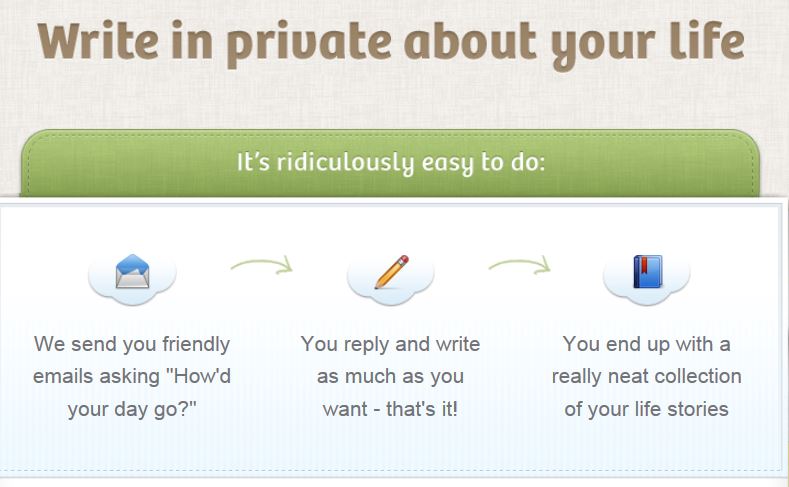
Once you sign up, the site sends you an
email every day (at whatever time you specify) and asks “how did your day
go?”  You email it back and it stores the
information privately on a cloud.  At the
bottom of the emails they send what you were doing that time last week (or last
month or last year, if you’ve been with the journal that long.)  OhLife also encourages you to write only a
sentence if that’s all you want to write…and to 
skip days, if needed.
You can attach a picture to each post, if
you want to enhance your post.
You can also download a .txt version of
your journal if you want to make sure you have a backup in case for some reason
the site discontinues.  I ordinarily
wouldn’t even think about this possibility much, but the sudden discontinuation
of Google Reader has made me a paranoid user in all aspects of my online life.
I’ve really enjoyed OhLife and have recommended it to several of my family and friends. I’ve apparently become an OhLife evangelist.
Getting the emails seems to do the trick
for me in terms of keeping up with it. I haven’t missed a day yet. I type
quickly and it’s much easier to remember to write an entry if I’m being
reminded each day.  And it’s not like I
don’t check my emails. :)  Although I
like the idea of writing in a physical
journal each day and I still love pen and paper…it just doesn’t seem to come
together for me or fit into my busy schedule like it used to. 
Journal uses for writers?  For one, establishing a daily writing habit, if you’re
not a daily blogger.  Journaling can help
you warm up, too, if you write afterward. Introspection.  It can be therapeutic, if you sometimes
have stressful days.  You could also use
it to track progress on various projects…meeting your daily word count goal or
looking into finding a cover designer and formatter, or tracking queries.
Or, if you’re like me, it’s nice to have
a searchable memory.  :)  My memory is abysmal and is certainly not
getting any better the older/busier I get.
One thing I know as a lifelong
diarist—don’t try to catch up.  It’s just
too frustrating to try to cover everything
in a journal.  Just jump in where you are
now. Sometimes simply making a list of the day’s highlights is a nice change,
if you don’t have much time.
Do you keep a journal?  Ever used an online journal?  If you do journal, what do you get out of it?

Updates on ACX Audiobooks and a New RSS Reader

 by Elizabeth S. Craig, @elizabethscraig

Just thought I’d write an update today on a couple of
different topics that I’ve mentioned recently.

One topic is ACX,
the audiobook distributor.  I’d mentioned
in
this post
that I ‘d made my self-published books available for auditioning to narrators
and outlined the process I’d gone through to get to that point.
I’ve found narrators for all three of
those books.  Once you listen to the
auditions on the ACX site, you make an offer to one narrator (there’s actually a ‘make
an offer’ link right underneath the audition) and send a note to the others, to
let them know.
A pop-up window will ask you to specify your terms for the contract.  Most of the contract is
set by ACX, but they’ll point out the areas you’ll need to give input (like the
payment arrangements…by the hour or royalty share…and your deadlines for
completion of both the first fifteen minutes and the project itself.)  Then you hit send and the contract goes off to the
narrator.
ACX asks that if we do any contract-type
negotiation or make specific arrangements or notes for the narrator, that we do
it through the ACX message system.  That
way there’s a record of our conversation in case there are any questions or
problems later.  In their words:

IMPORTANT:To be sure that you end up with a binding contract,
please work out all details of your Offer via ACX, using our internal
messaging system (simply by clicking “Send Message” on the Producer’s
profile). If you negotiate and agree to details via some other
channel—phone, video chat, whatever—those details aren’t going to be
reflected in our system, and you might not end up with the contract you
want, or any contract at all. And that’s not the safest way to work.

If the narrator is interested, he or she will accept the offer
through the ACX site.  Once the first fifteen
minutes are completed, the narrator uploads the audio to the site (and,
once again, we get a notification email. 
I rather like these notification emails, though, since audiobooks aren’t
the only thing I’m working on.)  If we
accept their first fifteen minutes, we click the ‘accept’ link under the
audio.  We can also send a message to the
narrator with specifics regarding their narration. 
This way, if we’re not all on the same page, we can make sure we ask for
changes before the narrators  invest time in the rest of the book.
This is where I am in the process…I’ve
approved two of the three books’ first fifteen minutes now.  Each book has a slightly different
feel/narration to it since I’m getting all of the books done at once for the sake of
time.  But each sounds good.  Slightly campier sound to Dyeing Shame so far, but it’s a much campier
book than the other two.  The narrator
nailed that aspect of it.
On to the
other topic I’ve mentioned lately
(or fretted over in the comments): the
fact that Google is pulling the cord on Google
Reader
in July.  I was pretty exasperated when the news broke. It does bring up (as many others have
said) the issue of whether we can trust Google, or really any of these online cloud services.  We
believe they’ll continue a service, we invest time in it…and they discontinue
it.  
Since I subscribe to
2346 blogs to curate writing links for Twitter, I’m considered a
power-user.  I was a little concerned
about the process of migrating to another reader service and the possibility of
losing folders or blog subscriptions and having to face a time-sucking
challenge of restoring data or organization. 
I exported to several different readers,
but quickly found that my favorite was Feedly.  It was organized much the same way as Google
Reader (or, at least, we could configure it to be very much like Reader).  Here’s the big thing—it hasn’t crashed yet.  With the number of blogs that I work with on
the site, Google Reader would frequently crash—either freeze up, slow down
tremendously, or need to refresh, and I’d lose my place as I was working through the list of posts.   This hasn’t happened with Feedly
yet.  (Yes, I’m knocking on wood as I
type this.) It hasn’t crashed, despite a tremendous amount of influx by new users via the  exodus from Google Reader
(at one point, over
500,000 users migrated to Feedly in a 48 hour period
.)
All of my folders transferred over and I
didn’t lose any subscriptions en route to Feedly. 
I can read blog posts by title, if I want
to (that’s usually how I like reading them). You can also choose other views…a
tile-type view, full post view, etc.  Go
to “prefs” on the left-hand side of the screen, under your name, to make
adjustments to your settings.  You might
want to change the Feedly default settings if you’re used to Google Reader.
One irritating thing is that Feedly isn’t
supported in Internet Explorer/Windows. 
That’s the only irritant so far, however.  You can use it on Firefox and Chrome or
Safari…I’m using it in Firefox.  Firefox
and I sometimes don’t get along, but it’s worth putting up with some conflicts
to get Feedly. 
Have you checked out ACX yet (US-only
right now, but I believe they have plans to be worldwide)?  Found a new RSS reader?Do you read blogs with an RSS reader?

10 Book Club Tips: Guest Post By Dina Santorelli

 by Dina Santorelli, @DinaSantorelli
To promote Baby Grand, my debut novel, I’ve done all
kinds of appearances. Bookstores. Libraries. Assisted living communities.
(Street corners.) 
But probably my absolute favorite thing to do is attend book
club meetings. Sitting in a casual circle, talking about the book that I wrote
and everyone read, eating, drinking and, most importantly, seeing up close how
readers have responded to my book, how they’ve taken ownership of the
characters and defend them, fight for them, question them, hate them, love
them. It’s pretty cool. But in addition to being a great way to spend an
evening, book clubs offer tremendous marketing opportunities. Here are 10 ways
authors can make the most of their book club appearances.

1. Put together discussion questions. Whether
the book club has a facilitator or asks you to serve as facilitator for
the evening, bring handouts for all the members that include discussion
questions and distribute them before the meeting gets started. This will
eliminate any worries of “what will we talk about?” and also gives members
a heads-up on what kinds of things you have in mind to discuss, which
gives them a chance to think about their comments (some people get stage
fright).

2. Distribute contact info. I like to maintain
relationships with book club members long after the meeting, so I give out
my contact information (email,
Twitter, Facebook, etc.). I
usually include this on the handout I’ve distributed, but you can also use
business cards or bookmarks, if you prefer.

3. Post/pass around a mailing list sign-up sheet. As an
author, you may (should) already have a
mailing list—an opt-in list of
folks who have agreed to let you send them your news. Book clubs are a
great place to grow your mailing list, because they offer readers who not
only are familiar with your books, but like them enough to have you appear
at their discussions. You can put your mailing list sheet—mine is usually
attached to a clipboard, looks more official that way—in an accessible
place, perhaps near the room entrance, and ask people to sign up if
they’re interested in receiving more info about you. However, I find the
better way to go is to pass the clipboard around the room while we’re all
sitting in a circle—many times readers are interested in signing up, but
once the discussion gets going they often forget about the list, so
getting the mailing list out of the way or while the discussion is getting
started is more advantageous.

4. Bring a camera. Local newspapers are always looking
for news, and sending a photo of a local book club appearance is not only
exciting for the book club members, but it can help spread the word about
your book. I usually gather the members around for a group shot sometime
after our discussion and before dessert, so that we don’t have cookie
crumbs on our lips or lapels.

5. Bring copies of your book—and at least one Sharpie. While
dessert is under way, I usually pull out a Sharpie and begin an autograph
session. Many of the book club members will already have purchased my book
in order to participate in the discussion, but I find that sometimes
members want copies for friends, family members or colleagues. Or, if
they’ve bought the eBook, they might want an autographed hard copy as
well. Work closely with your book club contact to gauge how many books you
should bring. I usually bring 15 to 20 copies. Also, one Sharpie should
do, but it couldn’t hurt to have a back-up in case that one runs out of
ink.

6. Sell your book at a group discount. I offer Baby Grand at a book club discount for groups
of 10 or more. I find that, in addition to helping to sell books at the
actual book club events, a discount helps to entice book clubs to take on
your book as a reading selection in the first place — because book club members
are buying books all the time, they appreciate the opportunity to save a
few bucks where possible.

7. Suggest a theme for the meeting based on your book. Lots of
book clubs like to have theme-based discussions and often ask members to
bring food or desserts that cater to that particular theme. For example,
in keeping with the “mob” storyline of
Baby Grand, one club
had a theme of “Everything Italian,” and the book club organizer asked
members to bring wine, food and beverages that fit the bill. So there was
pizza, mozzarella and tomatoes drizzled with balsamic vinegar, Italian
chocolates and pastries, cannoli, espresso. It was so fun. And delicious.
And it got everyone in the mood for the book discussion. Reach out to the
organizer of the book club you’re planning to attend to see if they’re up
for some fiction-inspired fare.

8. Give ’em the inside scoop. Make your author appearance
special for the folks who are there, and let them in on some proprietary
info about your book. Give them the lowdown on how your book came to be,
some behind-the-scenes information or a preview of the book’s sequel.
Reveal what celebrity your villain was based on (mine was inspired by
Robert De Niro) or why you chose the book’s setting. Think of the stuff
you would like to know if you were meeting an author, and then go ahead
and spill your guts.

9. Publicize the events on social media. I often
post photos I’ve taken, an insightful comment a reader made, or a themed
food served at the meeting on my Facebook page, or my
blog. I also
spotlight a book club of the month in my monthly newsletter.

10. Have fun. This is probably the most important
tip. Be yourself. Let your hair down. Have a cannolo. Guffaw, if you dare.
For many of us, this is the reason we became writers: To have the
opportunity to share stories with readers. What’s more, after a night of
laughter and silliness and debating which one of us will be running away
with one of the main characters, I’m often approached to appear at another
book club (many readers are in more than one). If readers are having a
good time, then they’re apt to tell their reader-friends that they did.
And the best part? You get to do it all over again.

Dina’s bio:
Voted one of the
Best Long Island Authors for 2013 (Long Island
Press
), Dina Santorelli has been a freelance writer for over 15 years
and has written for Newsday, First for Women and

CNNMoney.com, among
other publications. 
Her debut novel, Baby Grand,
is a Top Rated Mystery & Thriller on Amazon Kindle. Among her nonfiction
work, Dina served as the “with” writer for the well-received Good Girls Don’t Get Fat and most recently
contributed to Bully, the companion book
to the acclaimed documentary. Dina is also the Executive Editor of Salute and Family
magazines for which she has interviewed many celebrities, including James
Gandolfini, Tim McGraw, Angela Bassett, Mario Lopez, Gary Sinise and Kevin
Bacon. Dina blogs about the writing life at http://makingbabygrand.com.
and will teach a publishing course this summer for Hofstra University’s
Continuing Education department. For more information about Dina, visit her
website at http://dinasantorelli.com.
Social media:
BABY GRAND summary:
In Albany, New York,
the governor’s infant daughter disappears without a trace from her crib at the
Executive Mansion. Hours later, newly divorced and down-and-out writer Jamie
Carter is abducted from the streets of Manhattan. Jamie is whisked upstate, where
she is forced by her captor, Don Bailino, a handsome, charismatic ex-war
hero/successful businessman, to care for the kidnapped child in a plot to delay
the execution of mobster Gino Cataldi – the sixth man to be put to death in six
years by hardliner Governor Phillip Grand. What prevails is a modern-day
thriller about family ties, loyalty, murder, betrayal, and love that’s told in
deftly interweaving narratives that follow the police investigation of the
missing Baby Grand, the bad guys who took her, and the woman who found the
strength to protect her.
Scroll to top