
Plow Ahead

plow

Thanks Elizabeth, for hosting me on your (terrific) blog. I’ll try not to alienate any of your regular readers.

Every writer has his or her own unique style/method/routine. There’s not a right way or a wrong way–only your way.

Here’s my method for writing the first draft. Maybe you’ll find something here to help you (I won’t be offended if you decide that doing the exact opposite is your best course of action!).

After I’ve completed my (fairly sparse) outline and drawn up character sketches for the main four or five characters, the prep work is done. Now it’s time to park my butt in the chair and start grinding out the words.

And that’s what it is for me–a grind.

My only goal is to meet my daily word quota. I’ve been known to walk away from my computer in the middle of a sentence, if I’ve nailed my quota.

First, I’ll reread the last few paragraphs to see where I am. If I’m beginning a new scene, I’ll make a few notes. What is my purpose in the scene? How will I drive the narrative forward? Who will be in the scene? Where will it be set? I want to have an idea of where I’m headed. My key concern is the scene’s conflict. No matter what else happens, it’s got to have some conflict, however forceful or subdued, overt or covert (yes, inner conflict counts, at least in my books).

Then I’ll start writing. The first paragraph is key. I try to set the scene in an engaging way and imbue the sentences with a good rhythm. I may take a few extra moments to make sure I’ve got it in reasonably good shape, then I’m off to the races.

I trust myself to write a decent first draft. I think this trust is important because it gives you “permission” not to be perfect. You don’t have to go back and make sure everything is exactly how you want it the first time through. Repeat after me: “That’s what the revision process is for.”

As I write, I’ll correct obvious misspellings and bad grammar, but I try not to spend much time on what I’ve already written–I’m focused on what’s ahead. Ever forward. Words, words, words. It’s all about the words.

If I bump into a fact I need to know but don’t, I’ll type “XXX” and keep going. I don’t want to interrupt my flow to look something up, and I don’t want to waste precious minutes lost in some crazy Internet search for the capital of Mongolia (and my, what cool traditional garb the Mongolians wear, and look, isn’t that a neat recipe for Mongolian stew, and is there a place called Inner Mongolia, and, boy, I sure could go for some Mongolian barbecue right about now, and...). I need to keep my eyes on the goal. (Super Tip: Turn off the Internet when you write, or allow yourself only three minutes per hour to check email.)

If I know, right then, that something will need attention, I highlight it in red. Ditto if I make a note to myself. Otherwise, I plow on (in the picture above, that’s me, dressed in my typical writing outfit, working the plow, imploring my muses to mush).

Every so often, I’ll check my word count. If it’s less than my goal (usually 1500 – 1750, depending on what I’m working on), I’ll keep going. If I’ve achieved my goal…I hit the save button and move on to something else.

Usually lunch.
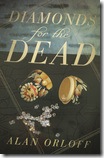
DIAMONDS 72 Alan Orloff’s debut mystery, DIAMONDS FOR THE DEAD, will be published in April by Midnight Ink. The first in his new series, KILLER ROUTINE – A Last Laff Mystery, featuring Channing Hayes, a stand-up comic with a tragic past, will be out Spring 2011 (also from Midnight Ink). For more info, visit www.alanorloff.com

Rearing Writers

Elizabeth in first grade Surprises are one of the fun things about having kids. You just never know what they’re going to do next.

And you sure as heck don’t know what they’re going to grow up to be. One day you’ve got a budding veterinarian on your hand, then next day a corporate lawyer.

I’d never dream of pushing my children to follow in my footsteps—whatever they want to be works great, as long as it takes them on a voyage of discovery.

But there are some basics I expect from them. :)

My friends have always been amazed that I can “get my children to tell me about their day.” This isn’t that much of a trick….I started early and I framed the telling of my day like a story. Now they tell me about their day in storytelling format—some days it’s a funny story, some days it’s a stressful story.

I want them to be able to discuss with me, in a fun way, books they’ve read—the good parts and the bad parts and the times they felt like the author really got off-track.

I want them to be competent writers, even if they never want to become a professional writer.

Here are some things I’ve done to encourage my children to be better writers (and readers. But reading and writing can go hand in hand.)

  • I tell them stories about their life (the day they were born is always a popular one.)
  • I tell them stories about my life and about their dad’s life, too (because he’s not a writer, but I know his stories well enough to tell them in an entertaining way). They love to hear stories about our lives when we were their age.
  • I make up stories at bedtime. My turning-13 year old son doesn’t hear as many of these anymore, but I tell my daughter a made-up story every night.
  • I read to, with, and in front of my children.
  • I spend time looking for books that suit their age and interests for them to read.
  • I tell them about my favorite books when I was a kid. Sometimes we read them together.
  • I share some of my writing with them and answer their questions about how it gets from my laptop to a bookstore.
  • I’m not critical about grammar or spelling errors when they write for fun.
  • I speak to their classes about writing, if the teacher asks me.

Kids are naturally gifted with creativity and it’s so rewarding to see it just bubbling out of them. There’s nothing better, for me, than to have my son ask me why I think a particular author’s recent release wasn’t as good as his others (looked to be rushed out 6 months after the previous book’s release) or to have my daughter ask if I would look at her new story.

They may never become authors, but I know they’ll always love books and know a little bit about what goes into making them.

Do you personally know any budding writers…kids or adults?

It’s Thursday morning—and I’m cooking up po’boys at the Mystery Lovers’ Kitchen. And just about setting my house on fire in the process…

15 Minutes to Write: The (Crazy) Writing Life

blog4 With the different deadlines I face, writing every day is a necessity. But even before I had deadlines, I wrote every day—just a smidgeon.

If I didn’t, then it was even harder the next day to get back into the groove. And my short writing session would drag out longer because I was writing slowly.

Writing really is a muscle that needs to be exercised. It’s easier to get back into your writing groove the next day if you’ve written the day before. Every day you skip makes it that much more difficult to pick it back up.

Another important reason to write every day? You get natural continuity of voice, pace, and plotting in your manuscript.

Lack of time is the number one excuse writers give for not writing. But if you can find 15 minutes, you can make progress on your manuscript:

Make a plan. Before you stop writing each day, jot down what you plan on writing the following day. This doesn’t have to be a major outline. Something as simple as “Dialogue—Kathy asks Jenny about her feelings about the murder victim and where she was during crime” will work out great.

Note where you left off the day before. Your fifteen minutes will be shot to Hades if you spend it rereading what you wrote the previous day. Again, a short note works well: “Kathy finished discussing the crime with Sam, left the park, and mulled over the potential suspects.”

Be forgiving and uncritical. This is a quick writing session to move your plot forward as much as possible in 15 minutes. You’re not going to write spotless, perfect prose here.

Open up to writing on the go. We’d all love to have a quiet, scenic little writing cabin to escape to. The reality is that many of us are writing on lunch breaks, while waiting for the train to arrive, in carpool lines, or pediatric waiting rooms. If you can learn to block out the world around you and quickly jump into your manuscript, you’ll get a lot more done.

Come equipped. There’s nothing worse than finding a small pocket of time in your day and not having anything to write on. Make a point of having a notebook in your car, desk drawer, and purse. Make sure to pack pens and pencils. Sometimes it’s just easier to whip out a piece of paper and a pencil than taking out your laptop.

But what if you only have 5 minutes to write?

It can be done! I have done real work on my manuscript in five minutes. Here’s how:

Character development: In five minutes, you can list as many things about your character as you can think of. They’re people—what do they like, dislike, and absolutely abhor? What are their pet peeves? Although this list may never make it into your manuscript, the point of the exercise is to give yourself more insight into your character and provide them more depth when you’re writing about them.

Character description: This is an easy exercise to do in 5 minutes. Describe your character. What do they look like? Sound like when they talk (loud speaker, soft speaker)? Do they smell like peppermints? Use your senses.

Setting description: Again, this is the perfect exercise for a 5 minute session. Pick a setting in your manuscript and elaborate on it.

Brainstorm 5 ideas for the next scene in your WIP: You do have one. This is your perfect time to think ahead and, off the top of your head, come up with five ideas for it. They can be as zany or as sedate as you like. Who knows what direction your story could go in? A little quick brainstorming session can open up new possibilities.

If you’re squeezing writing into a busy day, you’re far ahead of the curve. And just five or fifteen minutes a day can put you on track for finishing your first draft.

How do you squeeze writing into your day?

Freaking Myself Out

Bastubadaren--Tora-Vega-Holmstrom-1880-1967

So y’all know my philosophy toward writing a first draft—get the thing thrown on paper. Don’t stop to edit. Don’t stop to research. Don’t stop to think up last names for these characters, just mark them *** to make later. Just get the first draft done.

So five or six weeks into the process, I have a first draft.

And boy, does it need revising!

I’m now revising my first draft of the Memphis Barbeque series book two. And I’m reading along, thinking that actually, it’s pretty clean. Wow. Maybe, considering this is my 5th book, I’ve gotten this process more down-pat.

Then I read a scene from my WIP and I’m like, “Wait. Didn’t I have this scene ten pages back?”

And I did. Same scene, different words, same concept. Ten pages back.

Whups.

How could this happen? I’m guessing that when I picked up my writing one day (picking up from where I thought I’d left off), I thought I’d brainstormed the concept for the scene instead of actually writing it. But no, I’d already written it.

Just one of the hundred things you catch during the second draft.

I immediately turned on myself. I had been happy with this manuscript and suddenly I was feeling 180 degrees opposite.

Ways to Get Back on Track (and Forget the Screw-ups):

Treat our own writing with some emotional distance. This is hard, but I’ve made it work before. Pretend that what you’re reading is something you’re reviewing for a critique group. Don’t take the errors personally—just fix them.

Reading published books in our genre with a critical eye, highlighter, and red pen. Treat it like English class, keep an emotional distance from it.

Know when enough’s enough. Have you picked your manuscript to death? You’ll know it’s been picked to death if you read through a few passages you’ve just edited and the whole soul of the story is missing. The spark has been edited out. Maybe at this point it’s time to give the manuscript to someone else to look over for you.

Remind yourself that you’re your own worst critic. So many of us are hardest on ourselves than any editor or agent could ever be.

Remember we’re all in this boat together. Are there authors who don’t have a rigorous editing process? If there are any, I don’t know them! We all look at the first draft with some anxiety or disgust. The first draft is what it is…it’s the bones of the story. The most important thing is getting it down on paper.

I do my best revision writing when I’m not picking on myself for whatever mistake I’ve made. By keeping positive and keeping some distance from the manuscript, I’ll make the editing process go a lot smoother.

How do you keep your mistakes in perspective?

Scroll to top