Synopses

blog70 I’m not an outliner.

And I’ve been fortunate that I haven’t had to write a synopsis for a couple of years.

But suddenly I’ve been requested to write a full synopsis and 3 chapters for a possible new series.

A synopsis…of material I haven’t actually written? Sounds very like an outline to me….only it won’t lay out the story chapter by chapter.

Seems like a good time to learn to write from an outline. :) In publishing it pays to adapt.

I’m thinking they’ll be looking for about three, double-spaced, single-sided pages. Since the book would be sold on the synopsis, before it’s written, though, they might want to see more. After I write the three pages, I’ll elaborate for a longer, more detailed synopsis, in case they want it.

Here’s my plan:

I’ll brainstorm my story the way I always do…with my first victim, then the suspects. I’ve already gotten my sleuth nailed down, so I think I’m good there. When I’ve gotten a handle on my victims and suspects, I think I’ll be ready to start writing the synopsis.

I’m going to take key points of the story as I brainstorm, and jot them down, working out the plot with my usual what-iffing. I’ll pretend I’m giving someone a long summary of the book instead of the usual elevator pitch I give folks who ask about it.

I have a feeling that as I’m dreaming the plot up, I’ll be getting subplot ideas and probably secondary character ideas. I’m going to put those in a Word file and not in my synopsis unless the subplots or minor characters tie into the main plot in a major way at the end (mine sometimes do.)

Minor character tie-ins aside, I’ll include only main characters. I’ll probably briefly describe the character– something along the lines of “Ann asks JIM why he was near the crime scene. Jim, the victim’s emotionally-dependent only child, responded that…”

I’ll be dealing with suspects, so I’ll be explaining how they react during the investigation—if they’re evasive, misleading, etc. That’ll show, not tell what they’re like. When I name a main character for the first time in the synopsis, I’ll put it in all caps. Most minor characters will just be tagged in my synopsis– the neighbor, friend, police officer, etc.

I don’t usually decide who did it until close to the end of the book. Clearly, I won’t be doing that this time. Instead, I’ll still have all my suspects have equal motive, means, and opportunity. I can decide at the end of the synopsis who did it, but when writing the story from the synopsis/outline, obviously I’ll write it knowing who the killer is from page one.

As always, synopses are 3rd person, present tense. It’ll tell the story in a conversational style, including the key plot points from the beginning of the book to the ending—and, yes, the ending will name whodunit and why-dunit.

With the genre I’m writing (cozy mystery), the setting is important, but not overblown descriptions of the setting. Instead, I’ll be giving a town name and a pithy description of the area. So, something like: “The story takes place in Bradley, North Carolina, a tiny town where neighbors keep a close eye on each other.”

I love dialogue.

There will be no dialogue in the synopsis.

I’ve got some ideas that I think will work. I’m going to just hunker down this week and work through them and figure out my plan for the book. This process is definitely a little different from my norm, but I like trying new things.

Have you ever crossed over and written via an outline when you haven’t before? Or vice-versa? How did it work out?

A Writer’s Support

Le Coin du Village 1926--Valerius de Saedeleer-1876-1946 I’ll say straight out that non-writers are frequently not sure what to make of the writing life.

Why would someone put so much time, research, and energy into something that pays so little?

Why would someone open themselves up (repeatedly) to hurt from rejections or snarky reviewers?

Honestly, it’s really not something that makes a lot of sense. Most writers feel driven to write…and it’s important enough to us to ignore the long hours, low pay, and potentially harsh feedback from first readers, agents, and editors.

But having a little support is very helpful. And maybe you’ve got it with your family and friends… maybe you don’t.

If you’ve got zero support or if people don’t even know you write, I’d definitely recommend the online writing community. Blogs are great places to connect with other writers (find active blogs to follow, then branch out and follow folks in their blog rolls. Don’t lurk!) , but so are forums like Absolute Write and Writers Net which connect writers with each other and with resources and information.There are also Yahoo Groups that operate on an email loop (or you can choose to visit the group’s board). Just go to http://groups.yahoo.com/ and search for “writing” or the genre of your choice.

You can find writers on social media, too. We’re all over Facebook. If you befriend me (and I’ll friend just about anyone), then you can easily find friends in my friends’ list who write. You can do the same for any writer out there.

Twitter has tons of writers on it. If you put #amwriting or #writetips or #writechat into the search box on your home page, you’ll find writing tweeter

If you’re looking for in-person support, try local writers’ groups. Even small towns frequently have them now. Do a Google search: “Your hometown+writers groups.” You can also ask your local library—the research librarian will know, for sure. Several of the staff at my local bookstores (both independent and chain) are well-connected with the writing community, too, I’ve noticed.

Friends and family might not exactly understand why you’re writing, but can be supportive in small ways.

I don’t think it’s necessarily important that they understand the “why.” I’m not sure that anyone who doesn’t write would get it unless they have an equally time-consuming activity that they’re passionate about. But family can be supportive in different ways.

My husband has functioned as my patron of the arts. :) The small income I make from writing isn’t enough to make a living on, but he’s always provided the resources (and, with the resources, comes time to write).

My children promote me to their friends and their friends’ parents—while I usually don’t mention my writing to others. Their pride has led to many sales I wouldn’t otherwise have made.

Maybe your support came from long ago. A teacher could have let you know you had talent. A grandmother or father might have engendered a love of books by reading to you. I was lucky enough to have both encouraging teachers and a family that promoted books and reading.

And, since today is Mother’s Day in the States, I want to make a shout-out to the mothers out there…many of whom are incredibly supportive.

My mother made sure that daily reading was incorporated into my day when I was growing up. She understood where my talents lay and didn’t chide me for mathematical incomprehension (although she set up tutors to help me.) She cheered me on when I got internships at magazines and then writing jobs at magazines. She encouraged me to start back writing after I’d had a dry spell with my first child was born.

She’s my only first reader now and does a great job steering me in the right direction. She’s also a tireless promoter— arranging book signings for me, a book club talk, and a library presentation. And she talks me up to her friends…and maybe even people who don’t want to hear about me and my books. :)

Thanks Mama. Happy Mother’s Day.

Conference Pictures

Pictures from the 2010 Malice Domestic conference held last weekend in Washington, DC. I had a fantastic time, met many online friends in person, spoke with some wonderful mystery readers, attended and sat on panels, ran my mouth a lot more than I usually do…and came home exhausted, but happy!

image

Here I am hanging out with my Mystery Lovers’ Kitchen friends, Avery Aames and Krista Davis right before the Agatha banquet. Avery writes the Cheese Shop mysteries and Krista writes the Diva series for Berkley Prime Crime.

No, we didn’t plan on wearing the same color. :)

061

These are all Midnight Ink authors (left to right): Vicki Doudera, G.M. Malliet, C.S. Challinor, Elizabeth Kane Buzzelli, Lisa Bork, me..hidden:) , Beth Groundwater , Deborah Sharp, Alan Orloff, Sue Ann Jaffarian, and Kathleen Ernst.

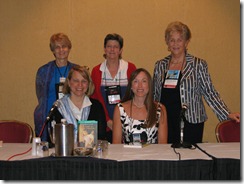
This picture was taken right before our Saturday panel: Senior Sleuths vs Middle-Aged Meddlers and Crime-Cracking Kids: How Age Impacts the Story. Bottom Row–Sarah Masters Buckey, me
Top Row–Maya Corrigan, JL Wilson, Nancy Glass West

imageSarah Masters Buckey with me, before our panel. Sarah writes the American Girl series. My daughter thought that was really cool.

025Alan Orloff, Sue Ann Jaffarian, Vicki Doudera, and me—on our way to grab a little lunch.

imageAuthors Cheryl Solimini and Elizabeth Zelvin and me

027

055

Cozy mystery writers Lorna Barrett, Krista Davis, Ellery Adams, Sheila Connolly, Leann Sweeney, Wendy Lyn Watson, Heather Webber, Mary Jane Maffini, Avery Aames, and I had buttons made up for a button game where readers hunted down all our buttons at the conference. Whoever got all the buttons first, won. Our winner, Shirley, with our button collection!

image

Berkley Prime Crime treated its authors to dinner at Ruth’s Chris Steakhouse on Friday evening. The staff at the restaurant really bent over backwards to make sure everything went well. :)

035

Natalee Rosenstein,Vice President and Senior Executive Editor with Penguin Group, with Berkley author Casey Daniels. It’s not often you can hang out with Penguin editors (much less a VP), so this evening was a treat.

063

The Malice banquet.

image

Kathleen Ernst and Alan Orloff speak during their panel, Culture Clash: Race and Ethnicity in Mysteries.

046

An aerial shot of the area where the authors signed books after panels.

057

Goofing off time. :) With Beth Groundwater, Elizabeth Kane Buzzelli, Deb Sharp, Alan Orloff, and Lisa Bork

To everyone that I met and hung out with last weekend—it was wonderful meeting you all!

Twitterific

Twitter

Once again, I’m posting writing links that I previously posted to Twitter.

The idea of doing this isn’t to overwhelm anyone. But I thought that if I kept track of these writing links in a searchable database (you can search my blog on the top left of the page) then we can access some of these helpful links by topic, when we need to.

One author shares lessons he’s learned: http://bit.ly/aYUXsA

What makes a writer a professional? http://bit.ly/bfzoXo

A published author gives aspiring authors the benefit of her hindsight: http://bit.ly/bOaM3c

Eliminating vague pronouns: http://bit.ly/csi4ZS

Delegate your way to more writing time: http://bit.ly/brx70y

The Evolving World of Book Publicity (Huff Post): http://huff.to/9pILeo

Men don’t read books? Research Fail: http://bit.ly/9bcKIj

Is DRM More Costly Than Piracy? http://oreil.ly/bxzKoK

8 basic writing blunders (Writer’s Digest): http://bit.ly/dBiuok

Bringing your characters to life: http://bit.ly/c3pme8

A query and a rejection (snort): http://bit.ly/9nc5Bi @thmafi

What readers want: http://bit.ly/aqzWjj

Bowker to provide ISBNs for Google Editions– http://bit.ly/bPM769

Write, exercise, write: http://bit.ly/aiIofH

Brainstorming techniques: http://bit.ly/bClIDK

On Facebook and the Increasing Erosion of Digital Privacy– http://bit.ly/dAHIzA

Amazon—or Shamazon? inside customer reviews– http://bit.ly/a6dE0C

Literary Agent Steve Wasserman Delivers Digital Rights Advice for Authors @GalleyCat : http://bit.ly/bn2rj8

The art of choosing illustration (write picture books? Don’t try to pair the text w/ pictures): http://bit.ly/97cVGY

Changing times for the promoting writer: http://bit.ly/9dLQ7P

5 articles on writing with voice: http://bit.ly/aC5MZP

Fantasy’s Top Ten Fight Scenes: The Duels– http://bit.ly/9h9bL1

An author discusses fanfic: http://bit.ly/92YBzA

Google to launch ebook store (Guardian): http://bit.ly/cJaomx

Literary novels don’t have to be plotless – Revolutionary Road– http://bit.ly/dcMs8j

It’s Time to Realize You’re a Talentless Hack– http://bit.ly/abXv8p

Know Your Characters – Part 1– http://bit.ly/aNXtk1 @jaysubject

3 Things Don Corleone Knows About Writing– http://bit.ly/alvp6i

Notes from the NY Times newsroom on grammar, usage and style: http://bit.ly/bnAJFy

Virtual Book Tours for Novelists: http://bit.ly/dtLrUC

Top 10 illustrated books for adults (Guardian): http://bit.ly/a1ijuX

Where’s the Future for Science Fiction? http://bit.ly/aGjS0I

One question an editor always hears: http://bit.ly/9esvyf

What should I write? http://bit.ly/dbgEbi

How To Organize Your Google Feed Reader: http://bit.ly/c9dK96 @TannaC

You don’t know jack about ISBNs: http://bit.ly/dxd9Ji @ereads

Writing characters–must we stick to what we know? http://bit.ly/bq9pxA

Setting up a critique group–think quality, not quantity: http://bit.ly/c9P3Bo

What Swiss transportation can teach us about writing: http://bit.ly/aXocAH @WriterAbroad

How a good scene is like a good joke: http://bit.ly/aquxLp @julie_bush

Showing vs. Telling: Subtexting — http://bit.ly/a5aNG1

Tips for writing success: http://bit.ly/ckSXW7

The worst things an agent has seen in contracts: http://bit.ly/c7PDFu

Ways the writing life can enrich our families: http://bit.ly/bVjfAY @JodyHedlund

Building a villain: http://bit.ly/dlyove @msforster

“Connect, Don’t Network”: Gaiman, Benet on Blogging– http://bit.ly/9vCyJH

10 Marketing Excuses That Can Kill Your Book and Career: http://bit.ly/bx2HtS

Why men don’t read (Salon): http://bit.ly/cZbvg7

An agent on keeping our facts straight with series bibles: http://bit.ly/d8ksnD

13 Things You Should Have Known About Your Characters Beforehand: http://bit.ly/9p7nUv

5 tips to survive an agent meeting or pitch session: http://bit.ly/c2EUp6

Handwriting analysis, part 2, for the crime writer: http://bit.ly/bkEH5Q

Margaret Atwood on why we must defend writers (Daily Beast): http://bit.ly/99SmiP

Quoting song lyrics in your fiction: http://bit.ly/bInVs7 @nickdaws

Writers and the internet (can authors survive it?) : http://bit.ly/dCKKfq

Formulating your workshop goals http://bit.ly/cy41mq

Advice for a Mystery-Hater: http://bit.ly/dbreJn

When did “beware” become a noun? http://bit.ly/bPCAkx

Cross-dressing characters: http://bit.ly/bRfxoc

Going to Paris? Events and news for writers: http://bit.ly/9wx8zs

Why Your Email Account May Be Getting You Rejected– http://bit.ly/d59aUo

Writing From the Incomprehensible– http://bit.ly/9RGTV0

Working with an editor– making it productive: http://bit.ly/aK4Okb @greyhausagency

Best last lines in books: http://bit.ly/byzlnc

The phrase-finder…another online site to help you procrastinate: http://bit.ly/9BxpVC

7 Secret Signs an Agent is Into You– http://bit.ly/94kYXe @thmafi

What’s Jodi Picoult looking for? Respect. (Telegraph): http://bit.ly/bfRBV4

Not Just Another Funny Forehead: Creating Alien Characters– http://bit.ly/dhc2DB

On writing acknowledgments: http://bit.ly/bB1fAU

The writer’s toolkit: Eavesdropping for dialogue– http://bit.ly/bDkcSN

He says/she says: What is creativity? http://bit.ly/b0IN1F @merrileefaber @cvaldezmiller

Workshop tips from the SCBWI Michigan Conference: http://bit.ly/b2Ja5w

Authors, do you look the part when doing TV promo? (Huff Post) http://dld.bz/cevW

Authors, do you look the part when doing TV promo? http://www.huffingtonpost.com/arielle-ford/do-you-look-the-part_b_559913.html

For book marketing research, authors can use TitleZ– http://dld.bz/cev9 @TheCounter

Teaming up with another writer for offline promo: http://dld.bz/cevv @TonyEldridge

107 Things You Should Know About Being a Published Author– http://dld.bz/cevs

Lessons learned–my first writing conference: http://dld.bz/cevn @bluemaven

Editors on agents: http://dld.bz/cetG

Reading around the world–in photos. (LA Times): http://dld.bz/cenK @LATimesbooks

An agent on synopses: http://dld.bz/cenC

POV tips– http://dld.bz/cen8

Reading a publishing contract–part 9: http://dld.bz/cem8

On using coincidences when we write: http://bit.ly/bo1YnS

An agent throws a little cold water on agents fighting over the same client: http://bit.ly/c30bcH

Do libraries help or hurt book sales? http://dld.bz/cemv

Book Marketing–experience & options — thoughts on different approaches: http://dld.bz/cewz

Posting Your Unpubbed Concepts On Your Website: Yes or No? http://dld.bz/cekB @jkcoi

Know your children’s lit category: http://dld.bz/ceww

Content farms: http://dld.bz/cebU @Personanondata

Writer @JulieHyzy reminds us it’s prom season–and gives us a recipe for a spinach quiche to serve. http://bit.ly/cvwony

An agent on how to write the breakout novel: Part 2 – Larger-than-life characters: http://bit.ly/bq9b9y @JuliaChurchill

Storytelling is Motion: http://dld.bz/ceaR @gwenbell

Top 10 Greatest Science Fiction Detective Novels Of All Time: http://dld.bz/cend

Fiction Magazines Worth Reading: 2010 http://dld.bz/cenw @ericrosenfield

Powerful WordPress Forms Made Simple– http://dld.bz/cemY

Kindle pros and cons: http://dld.bz/cecq

The best book I ever edited: http://dld.bz/cebw @jevonbolden

Quidditch–fictional? Think again: (Guardian)– http://dld.bz/cemB

The Trials and Triumphs of Turning a Print Novel into an eBook: http://dld.bz/cec3

The Facebook writer’s challenge: http://dld.bz/ceaP

Steve Wasserman on the Qualities of a Good Literary Agent– http://dld.bz/cemq @GalleyCat

A few rules for romances–and what’s hot and not: http://dld.bz/cewf

Factors that influence character names: http://dld.bz/cayz

Why do editors edit? http://dld.bz/ced9

Great tips here– A Writer’s First Year: “Do Not Snort on NPR” and Other Tips for Flogging Your Book http://dld.bz/cefy

What’s your intent or objective for being on Twitter? http://dld.bz/cecM

Writer Jeff Cohen comes up with “The English/GPS–GPS/English Dictionary” while on the road: http://dld.bz/cayu

Starting a novel in the wrong place: http://dld.bz/cdYq

What every fiction writer can learn from Starlighter: http://dld.bz/cdYm

Conference etiquette–be a class act: http://dld.bz/caxZ

No idea is wasted when we write: http://dld.bz/caxX

10 writing tools you can have for free: http://dld.bz/cawj

Poetry is for rich kids: http://dld.bz/caxQ

A good writer is a good writer–whether it’s genre fic or lit fic: http://dld.bz/cax2

10 Handy Travel Gadgets for Geeky Business Travelers– http://dld.bz/cawm @marcandangel

What you should do with every guest post you write: http://dld.bz/cawe

Science Fiction and Romance: Fraternal Twins– http://dld.bz/cavQ

Monday Markets/Jobs/Opportunities — http://dld.bz/cau5

How To Get Your Book Mentioned In A Newspaper: http://dld.bz/cau3

Distractions–how they hold us back. http://dld.bz/cauw @joannapaterson

An agent on what’s in a publishing contract: http://dld.bz/catk @RachelleGardner

What you’re entitled to, as a writer: http://dld.bz/casQ @julie_bush

When to start your agent search: http://dld.bz/casK

Maid as Muse: How Servants Changed Emily Dickinson’s Life & Language: http://dld.bz/cavN

Comparative overkill–how to compare and contrast in our writing: http://dld.bz/cas6

Writing conversations– how many people should converse at once? http://dld.bz/caYK

Skype is not quite ready for prime time: http://dld.bz/bYpm

Romantic Times conference wrap up: http://dld.bz/bYpk

How to use mysteries in your novel: keep the reader guessing – but not too much http://dld.bz/bYph

Can Goodreads Ads Help Unknown Authors Find an Audience? http://dld.bz/carP

3 vital steps to writing a novel: http://dld.bz/bYpe

Action and intensity = 2 different things: http://dld.bz/bYnH

Why write? http://dld.bz/bW7f

Why I don’t say ‘science fiction’ or ‘fantasy’ to regular people: http://dld.bz/bW6X

When your story doesn’t turn out like you planned: http://dld.bz/bW6M

Dealing with scraping (plagiarism) from a blogger’s point of view: http://dld.bz/bW6E

Will sex save publishing? (MSNBC): http://dld.bz/bW6y via @AuthorScoop

Writing the hardboiled–keeping it edgy: http://dld.bz/bW5X

An agent answers a writer’s question–would she rather rep a writer with a deal on the table? http://dld.bz/bW5V

When you hate your book: http://bit.ly/d8A70e @kirstenhubbard

Handwriting analysis or graphology: http://bit.ly/a78mLZ

Can the Author Survive the Internet? (Daily Beast) http://bit.ly/cj33Io

Plot is presentation: http://bit.ly/a4gY6d

Links to Savvy Book Marketing Tips for Authors– http://bit.ly/cajYC9

How to read a publishing contract (part 8): http://bit.ly/dyqsVO

Some gun tips for the crime writer: http://bit.ly/bcD0cJ

Foreshadowing: http://bit.ly/968Mk5

Fiction’s talking animals (Guardian): http://bit.ly/a5L3Gc

I’m a writer–let me tell you a story: http://bit.ly/dixga8

Ten of the best visions of Heaven in literature (Guardian): http://bit.ly/aYy27G

What you should know about non-writers: http://bit.ly/cmtSeP

Blake Morrison on the cost of quoting lyrics (Guardian): http://bit.ly/cPXwNM

Author toolbox–the 3 hooks: http://bit.ly/9pM2z6

Traditional book retailers face trilogy of threats: http://dld.bz/brqt

How poetry, Google, and Craigslist helped me find the family I never knew I had– http://bit.ly/a2Rnj4

Meet the Telegraph’s cryptic crossword maestro: http://bit.ly/bwvMuB

Adding Extra Content When Republishing a Novel as an eBook: http://bit.ly/bZoWKp

Never give up–a probable possibility: http://bit.ly/9tuW3N

What to Do When They Hold Your Guest Post Hostage: http://bit.ly/bKt8LQ

What’s really preventing me from writing? http://bit.ly/b6G8jH

How do I choose which book to review? http://bit.ly/cFIYJw

7 deadly sins (if you’re a first chapter): http://bit.ly/a5NeQ4

Climbing Pyramids and Other Writing Exercises: http://bit.ly/cm76yc

The Eternal Questions: When, Where, How– http://bit.ly/92pfyc

How to travel lightly to literary events: http://bit.ly/bm29o1

What’s in a name? http://bit.ly/apXDHO

Should you query a first novel? http://bit.ly/a9k3Ht

The ‘do it now’ principle: http://bit.ly/8ZBuBU

Self-promo–starting too soon? http://bit.ly/9libJe

What booksellers want: http://bit.ly/9dTad0

How Transmedia Storytelling Becomes a Billion Dollar Business: http://bit.ly/d5Zx5p

Dramatic monologue (Guardian): http://bit.ly/dcQA9l

What’s in a Name? — http://bit.ly/apXDHO

Five Things Phishing And Literary Scams Have In Common– http://bit.ly/ab7HFN

Censorship–the ultimate ignorance: http://bit.ly/9Lz4om

Why branding yourself is important: http://dld.bz/bAFG

Changing Times

Deadlines When I was at the Malice Domestic conference last weekend, I had a chance to talk with an author who currently has a successful series with a major publisher.

When I was introduced to her, I immediately remembered a review I’d read about her last book in the series on one of the major book blogs.

“Oh, fantastic review on _____,” I said. (I don’t want to make it too clear which author this is, although I don’t think she’ll find out…and you’ll see why in a second.)

“Where?” she asked. She looked completely baffled.

“On ______,” I repeated.

“Is that a newspaper?”

I’m afraid at this point that my mouth may have gaped open and my eyes bugged out. Really?

“Um, well…no, but it’s a major book reviewing site online.”

There was some lost interest. I decided to change the subject since we’re locked into this conversation with each other.

“So, you’ve been doing really well,” I said mildly. That was an understatement.

“Yes, I decided to go on a 10-state tour of bookstores. I meet the staff, sign stock, get to know bookstore staff pretty well. Then I call on them when another book is released.”

Well, this completely blew me away. She’s young and has a family. And—traveling is expensive. And bookstore staff turns over pretty quickly. And…

But it was working for her. She was really successful with it.

I have to wonder, though, how long that approach will work so well.

And…why not at least monitor the online world a little? How many more sales would you get? How much more exposure? And for just a fraction of the cost of getting hotel rooms and putting miles on your car.

How long is there going to be print reviewing?

How long before books go digital and there are no “stock signings” as a promo option?

How long before you do need to go courting and visit book bloggers, and spend time on Facebook and Twitter? How much catching up will you need to do?

When I hear stories like hers, I feel a real mixture of feelings. Some guilt, definitely, at choosing not to do the same thing. But also a sense of wonder at her completely ignoring such a vital component of book promotion.

What do you think (and I realize I’ve got a biased group here since we’re all online and networking)? How long will the old-fashioned book tour last and be successful? Do you think there’s an argument for doing a personal-appearance tour as opposed to a virtual one?

Scroll to top