5 Star Reviews

lesfrm13_08a

I was speaking to a group of writers a couple of weeks ago when a question came up about what my opinion of a good review on Amazon was.

I winced, because I knew what the questioner was getting at.

If I were reading a movie review, 3 out of 5 stars means a good movie to me. Maybe it’s no Academy Award winner, but it’s good entertainment. It’s no waste of time to watch. 4 stars seems to mean very good to me…maybe a more complex plot with some top-notch acting. 5 stars? I should be watching Casablanca, Citizen Kane, or The Manchurian Candidate (1962).

Now, if it’s Amazon, then it’s totally different. Many of the published authors that I know consider anything less than a 5-star review something of a slap in the face. I’m not saying that’s right or wrong…I’m just saying that’s what I’ve heard. Of course, none of us feel good about a 1-star or 2-star review, but most authors aren’t rejoicing over a 3 or 4 star one, either.

If I were to apply the same rating system to books that I apply to movies, I’d make a book like The Complete Works of Shakespeare a 5 star, The Great Gatsby a 4 star (because it’s VERY good, but not really on par with Shakespeare), then I think many of the rest of us would be 3-star-good. Good entertainment… a nice read… good use of a reader’s valuable time.

Would I actually use this scale to rate my friends’ books? No, I sure wouldn’t. I wouldn’t have a whole lot of friends left. The way the Amazon scale runs is more like a recommended/not recommended rating—if it’s 5 stars, you heartily recommend it. If it’s fewer than 5 stars, in the Amazon environment, you’re not really recommending the book to others. I’m not saying this is right, but it seems to be what authors and what I think many Amazon readers believe. Amazon could practically switch to a Facebook-esque thumbs up or thumbs down symbol and just cut to the chase, if that’s the way we’re all treating their ratings.

To me, it looks a little phony to have all 5-star reviews. It has the appearance of being in cahoots with our reviewers. I just don’t think that everyone is going to love my book. I’d love it if everyone did, and I deeply appreciate the readers who feel that way, but the reality is that different readers enjoy different types of books. Some might love my book, some might think it was pretty good, some might put it down and pick up a thriller instead. I know I prefer some types of books over others.

The emphasis on a standing ovation review was driven home to me on Wednesday at the pharmacy when I was asked by my pharmacist to call a number on my receipt and complete a survey to be entered in a drawing. “But please,” he said, “don’t give us any fewer than 5 stars. Anything less than that is a strike against us, in Corporate’s eyes. If you’re only somewhat satisfied, please just don’t fill out the survey at all.”

It left me with a icky feeling that someone could suffer negative consequences from an overall favorable review of their service.

What do you think? Has Amazon changed the way we think about book rating and review? What’s a good review on Amazon? Are you hesitant to give fewer than five stars for a book?

Characters Who Grow on You

Blog7When I first took my now-14 year old son to kindergarten, I didn’t completely understand the elementary school carpool line. Actually, I didn’t understand it at all. And there seemed to be a lot of rules that I wasn’t aware of—where to turn in, which entrance was for what grade, where it was acceptable to drop off your child, where it wasn’t.

My very first day in the carpool line, I pulled up to the curb by the sidewalk that led into the school. But I didn’t pull up at the right place. As my son got out of the car, the teaching assistant—a stern-looking older lady—bent to look through my passenger window and fussed, “Excuse me! You’ll need to pull up allllll the way up here in your car. That way more cars can pull up behind you! We don’t have all day to unload!”

She was very indignant at my carpooling ineptitude. I was indignant, too. Here I was, a kindergarten parent with a baby in the backseat….how the heck was I supposed to know how the crazy carpool line worked?

We’ll just say that I started off with a negative impression of this teacher.

Over the years, though, I learned a lot more about the teacher from volunteering at the school. She has an old-fashioned way of phrasing sentences and a dry, sharp wit. She’s extremely well-read and sometimes makes obscure literary references that perfectly match whatever situation we’re in.

She’s now one of my favorite teachers at the school—and I think I like her even better than some other teachers because I so thoroughly disliked her at the beginning.

As a reader, I’ve felt the same way about characters that have grown on me. Particularly if the protagonist and I both share the negative opinion of the supporting character.

I remember, as a kid, thinking that Ben, the gardener in The Secret Garden was a total grouch. Then, as I reader, I found out with Mary that Ben was friends with a robin, was a real lover of nature, and was excited for Mary to start gardening.

Severus Snape in the Harry Potter series was another character that I detested at first, but then found really grew on me.

So I’m not really talking about a character that changes and becomes more likeable, I’m talking about one who stays the same, but has characteristics that make readers eventually, maybe grudgingly, like them.

I was thinking about this the other day in the carpool line, realizing I wanted to write some more characters that a reader can grow to like…because I’ve enjoyed reading them so much that I’d love to try my hand at writing one.

Have you read any characters that grew on you? As a writer, have you written any?

Building a World From the Ground Up—by Janice Hardy

The_Shifter_72As a fantasy author, creating the worlds my characters inhabit is half the fun. But it can also be a lot of work, because there’s so much you need to know to create a whole world – and most of it never even makes it into the book. To make this easier on myself, I like to use real places as a foundation and build my worlds from there.

For my adventure fantasy, The Shifter, I wanted to create a lakeside Venice, so I started researching the world’s biggest lakes. Lake Superior had interesting possibilities, but it was pretty deep and cold, and anyone building a city on a lake would probably need it to be shallow. Lake Tanganyika was an option, but it was too long and skinny for what I had in mind. I wanted my city to have a sense of isolation that only a vast expanse of water could create. Then I found Lake Victoria in Africa. Round, shallow, interesting geographic location—it was perfect.

Now that I had my lake, I researched what plants grew in that area, what people ate, and what kind of animals there were. All the little details that make a world come to life, and things that I could easily grab when I needed a detail for a scene. Fishing would obviously be important, so that would be a large industry and where most of Nya’s (my protagonist) odd jobs would come from. In a small city riddled with canals, vehicles would takes up a lot of space, so most people would probably walk. Carriages and horses would be restricted to the very rich or powerful. Instead, boats would likely be used to carry people and goods from one side of the isle to the other. With just a little research I could already see my world coming to life.

Darkfall_72I also found some fun real life details I could use. Like how water hyacinths are a problem around Lake Victoria, because they grow so fast and get caught in boat propellers. This translated into a problem my city of Geveg could have, with plants clogging the canals and boat owners needing someone to yank them out by hand. Sounded like a risky job to me, so why not make it even riskier by adding crocodiles to the mix? People desperate for a job would risk being eaten to pull a few plants now and then. And since I knew Nya was going to be poor, this could be something she might consider doing. (And it turned out to have devastating consequence in the third book, Darkfall)

Once I had a basic world foundation, it was time to think about the technology. I wanted my people to be advanced enough to have certain things like clocks and glass, but still maintain a fantasy feel (which can’t have too much science or it starts to feel like science fiction). I picked 16th century Italy, giving the world a Renaissance undertone. Education was available, books existed, commerce was more developed, but it was still an old-fashioned world. I cross-referenced this with the natural resources of my African lake climate, so I could see what technologies would have developed and which wouldn’t have. For example, if there’s no access to gold, then you don’t have gold smithing or gold jewelry.

Then it was on to style. (This is where the artist in me came into play) What would the art look like? How would these people decorate? Again, I went back to my base influences. The African lake and the Italian city. I decided to mix the two and go for a Byzantine feel. Arches, tiles, mosaics, beads, bright colors and patterns. Textures.

And of course, every culture has a religion (if not several). I decided to give my world a spiritual side, but not one that required the deities to actively participate in the lives of the people. Something that guided morality and faith, but didn’t dominate it. Saints popped into my mind (couldn’t even tell you what inspired that) and since the story involved sisters, I wanted to make all the Saints female and sisters. Alliteration naturally took me to the Seven Sisters, and that worked into the seven deadly sins. My Saints became the opposite, and represented the seven virtues. Nya’s patron Saint is Saint Saea, Sister of Compassion. That really fits Nya since she gets into the trouble she does by being compassionate.

Slowly, my world took shape, and it was time to start naming things. I used an African lake as a world foundation, so I thought it would fun to create names from African words. I chose Geveg as my city’s name, because geveg means struggle, which suits a city struggling under the occupation of enemy forces (which it is). That enemy is called Baseer, which is a derivative of beseer or hurt, because they’re the ones doing the hurting. Pynvium, the magical metal in my story, comes from pyn, the word for pain. Few people are ever going to know the meanings when they read the book, but having a little secret makes it more fun for me. And since Afrikaans is close to Dutch, I’ve actually had readers e-mail me asking if a certain name really does mean something in particular. Many of my names have hidden meanings in them, and you can get a hint about those characters if you happen to know what their name means.

Once you name something it’s yours, so I had my world and my story and I was ready to write it. And figure out what kinds of troubles I could cause poor little Nya in her fun little world. Because for me, the other half of the fun is seeing how my characters get out of the messes I put them in.

*********************

Janice Hardy RGB 72Janice Hardy always wondered about the darker side of healing. For her fantasy trilogy THE HEALING WARS, she tapped into her own dark side to create a world where healing was dangerous, and those with the best intentions often made the worst choices. Her books include THE SHIFTER, and BLUE FIRE. DARKFALL, the final book of the trilogy, is due out October 4, 2011.

She lives in Georgia with her husband, three cats and one very nervous freshwater eel. You can visit her online at www.janicehardy.com, chat with her about writing on her blog, The Other Side of the Story (http://blog.janicehardy.com/), or find her on Twitter @Janice_Hardy.

Writing Profanity

april fools 2010 020aIn the post, WTF is Up With Cursing in YA, agent Jennifer Laughran answers writers’ questions on offensive language and its location in a manuscript.

She also points out that you’ll want to make sure you’re not sending a profanity-laced book to a publisher that focuses on younger-YA books or clean YA. She states that profanity can work:

Provided of course that it is right for the character, that it makes sense in context and you aren’t just randomly throwing words around….cursing CAN be a lazy writer’s way of making a character seem “edgy.”

I write traditional mysteries, also called cozies. Use of profanity is generally discouraged in these books—it’s just not what the reader is expecting or looking for when they purchase a cozy mystery.

Conversely, if a reader has chosen a novel that focuses on the harrowing day-to-day life of members of a Mafia family…they’re going to be shocked if there’s no profanity. That would likely be something they’d expect (especially since Goodfellas and The Godfather have conditioned us to it).

So I think reader expectations can play an important role in whether a writer should include profanity in a book. Readers are, ultimately, the people we’re trying to please if we’re publishing.

Some things to consider when deciding on use of profanity in your book:

Would the character ordinarily use it? Is it realistic?

Does it make sense in the context? Is it really needed in the particular situation? Could it be left out and have the scene be just as effective?

Do you have to use dialogue with the profanity, or can you just state: Kevin cursed fluently as he hit his thumb with the hammer?

Does it fit your genre? Your audience?

Could it potentially be offensive to a reader, or is it fairly mild?

Is it distracting in the text? (By its frequency, wording, etc?)

Is it gratuitous? Is it there just for shock value or does it add something (realism, character insight) to the story?

Does profanity work with your genre and your intended readers? How much is too much?

*************************

Sign up for the free, monthly Writer’s Knowledge Base newsletter for writing tips and resources and to be entered in our first giveaway. Details here.


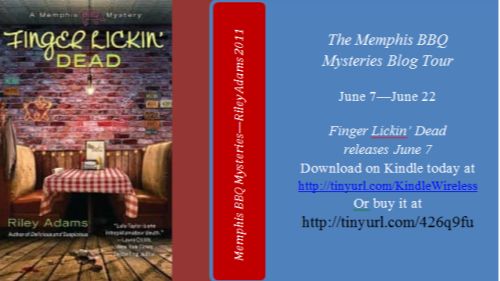
Finger Lickin’ Dead launches June 7th!

You Are Already a Writer. Now Write, Dammit. by Harrison Bradlow

If It Still Has A Head...Being a writer is not about how many people have read your work. It is not about getting an agent who will take you on as a client (or, for that matter, who will respond to your repeated contacts). It is not even about being published. If you have passion for writing and you’ve ever put a pen to paper, then you’re already a writer.

All those other things are nice, of course. There could be writers out there who don’t dream about being on the New York Times bestsellers list, but I haven’t met them yet. Being published in twenty-seven different languages, selling tens of millions of copies, and seeing your work transformed into movies starring Hollywood’s A-list celebrities would all be really cool. But nobody expects that of you right out of the gate, and you shouldn’t either.

I have been a voracious reader all my life, and I’ve always dreamed of being a published writer. Note the word “published” in there. That’s where the glamour comes from, isn’t it? Holding a book in your hand with your name on the front and your head shot on the back? That’s what I dreamed of. I didn’t stay up at night thinking about the actual writing process, which is weird, because that’s really where my passion was.

And looking back, I realize that in my own way I’ve been a writer most of my life. Even as a kid I wrote stories, mostly just for fun. Whenever a writing assignment came up in class I’d jump on it.

I remember in fifth grade we were directed to read a book and write a story about ourselves set inside the book’s world. It was a very creative assignment, actually. I chose “The Indian in the Cupboard.” The story, if memory serves, was supposed to be a minimum of five pages, typed and double-spaced. Mine was thirty-something. I’ve searched and unfortunately cannot find a copy of it anywhere.

I’ve always been a writer, but I wasn’t confident enough to call myself one, which is sad. I was shy about it. I didn’t dare share that passion with friends or family. I didn’t attend writing seminars. I didn’t take writing courses in college.

I thought I had to have an agent, or be published, before I could call myself a writer. I expected way too much out of myself, much as I imagine so many others out there do too. I thought that because I didn’t have my name on a cover, I wasn’t really a writer.

It took actually getting my name on a cover to realize how superficial that was. I recently published my first book, a work of poetry titled If It Still Has a Head, It Isn’t Quite Dead. I’ll probably never forget the moment when I first held a copy of that book in my hands. Wow. It was overwhelming. But after that moment passed, I realized something I should have known all along.

Books don’t make writers. Writers make books. Not having a book yet does not mean you’re not a writer. It just means you’re a writer who hasn’t made a book yet. I didn’t pick up that book and become a writer. I just picked up a book.

I’ve wanted to write all my life, but I didn’t pursue it until very recently, thanks in large part to encouragement from my wife. I should add, I didn’t even open up to her about my desire to write until long after I should have.

Why was I so afraid?

I don’t know. I suppose I was afraid of being judged, afraid of failure, afraid of all the things anybody might be afraid of before doing something new. That was probably natural for me. It was also really stupid! I put off doing something I loved, and for what? Fear?

I didn’t have the courage to share with my friends and family what I wanted to be until after I had that book in my hands. Can you believe that? I was publishing a book, and I didn’t tell anyone. It was among the most exciting things I have done in my entire life, and I didn’t tell anyone. It shouldn’t have taken me so long, and if you are in a similar place to where I was a year ago, don’t let it take you that long either.

Write, dammit. Set up a blog. Write poetry (it worked for me, which believe me, still boggles my mind). Write short stories. Post them online for all to see. Email them to anyone you think might read them. Solicit everyone and their mom for feedback. Grow.

In the process you’ll build a fan base as well, so that once you finally do have that book in your hands, you won’t be starting from scratch.

I was afraid. I can’t go back and change that, but perhaps I can help some readers out there who have similar fears overcome theirs faster than it took me to overcome mine.

*******************

Harrison is a very proud first time author. He invites readers to follow him on Twitter @Harrison314 and to visit his website: www.harrisonbradlow.com. His book, If It Still Has a Head, It Isn’t Quite Dead: A book of poetry on zombies, vampires, werewolves, ghosts, ghouls, and other generally scary monster-type creatures, is available online from Barnes and Noble and Amazon.com, among other outlets. Poetry excerpts from the book are available at his website as well.

Scroll to top