
“Where Do You Get Your Ideas?”

Incandescent_Light_Bulb“Where do you get your ideas?” is one of those questions that gets old fast. It’s also one of the questions you’ll hear most as a writer.

I don’t think I’ve ever gone to a conference or a signing or participated in a panel when I haven’t heard that question either before, after, or during the event.

I think my answer is the same as most writers. I smile and say, “You know, the ideas come all the time. I can’t shut them off! But they’re not epic ideas. They’re usually really small ideas that I can develop.”

For me, it’s only really occasionally that I’ll get a Super Big Idea. Even then, it might not be an idea that fits with the book I need to write. I mean, it’s great if I get a cool idea for a family saga that spans generations, but what I really need is a cool idea for a traditional mystery.

Instead of the Super Big Idea, I get little snippets of dialogue, character traits, an interesting quirk or personality type. Frequently these ideas show up while I’m at the store or in a conversation. I got them during book club last week and was guiltily texting myself the idea during the club meeting—realizing I probably looked obnoxious, but worried about losing the idea for good.

Sometimes I ‘m not even happy with the ideas I’ve got. Maybe they seemed like good ideas at the time, but once I started playing around with them on paper, they didn’t pan out the way I’d wanted them to.

In fact, one day in early 2010, I was working on my manuscript, Finger Lickin’ Dead (the book that’s releasing on Tuesday). The manuscript was in the early stages and I was exploring some of my ideas—and not liking them much.

I got an email from Hart Johnson. She’d had this really crazy, vivid dream, she said. It involved a murdered restaurant critic. She said that she knew she wasn’t going to write a restaurant mystery, and offered me the dream as a starting point.

And you know? It worked so much better than my idea! So I took her starting point, and Finger Lickin’ Dead was created. I mentioned Hart in my acknowledgments (thanking her for her ‘helpful suggestions’) and sent her a copy—which she showed off here.

Which goes to show, I think, that if we’re receptive to new ideas and not worried about trying a new direction for our story, we can really end up with a stronger book.

So now I’ll ask the never-ending question: where do you get your ideas? What’s the most unusual way you’ve received one?

************************************

Sign up for the free, monthly Writer’s Knowledge Base newsletter for writing tips and resources and to be entered in our first giveaway. Details here.
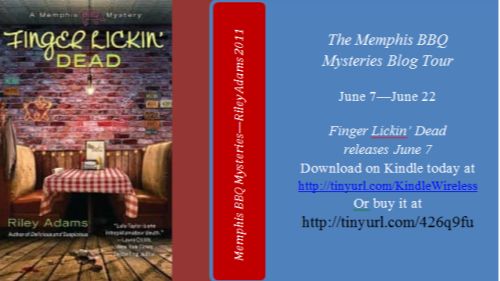

Finger Lickin’ Dead launches Tuesday, June 7th!

On Un-Revising

OLYMPUS DIGITAL CAMERA         Writing friend Camille LaGuire, wrote an interesting post on her Daring Novelist blog the other day.

Camille noted that she’d recently needed to un-revise (a term I think she’s coined!) a large portion of text in the middle of her manuscript. She said that her instincts were good (there was an area that needed work), but her efforts to edit the scenes she thought were causing a lagging pace led to some problems…then more problems. In fact, the revision created a sort of domino effect of additional revisions….and what’s more, it changed the plot, and not in a good way. She states:

And one of the things that happened with the misbegotten revision was that (a main character) sobered up to deal with some things in the middle. And that means the emotional trajectory of the sequence changes.

Camille makes the point that a character’s emotional state is trajectory… it powers the plot.

She had a character that was out of control, and his lack of control was powering the plot. Camille didn’t need to create a situation where this character regained control—she actually needed to increase his downward spiral.

The post resonated with me because I’d faced a similar situation in a manuscript. I had actually done a large revision, changing the murderer and the personalities of several of the characters. I’d put a lot of time into the changes, meticulously working through the manuscript to make sure that I’d switched everything to fit my revision and keep continuity in the new version.

But after reading it through, it just wasn’t right. I’d written it with particular character foibles that set off other character foibles and character reactions. Those reactions had triggered a particular series of events. It just didn’t make as much sense as the way I’d written the story before.

So I un-revised. And that was one of those times where I patted myself on the back for keeping old versions of my manuscript. I went back to the previous version and thought of a different way to approach my problem. (I ended up adding some additional tension to a couple of scenes, which worked well.)

Have you ever gone through a lengthy revision to find out it just didn’t work? Was it easy to un-revise?

****************************

Sign up for the free, monthly Writer’s Knowledge Base newsletter for writing tips and resources and to be entered in our first giveaway. Details here.


Finger Lickin’ Dead launches June 7th

Preparing For A Release

fingerlickindeadFirst of all, thanks to Diane at The Book Resort for a delicious review of Finger Lickin’ Dead. If you’re interested in finding out a little more about my book, please pop by!

It’s that time again! And I haven’t had a release for almost a year, so I really had to remind myself what I did the last time to prepare. I’ll have to remember better this time…because Hickory Smoked Homicide launches in November! Ack!

I wrote a post a couple of weeks ago that mentioned some of the things writers can do to promote a release. Some of those things were press releases, book trailers, press kits, launch parties, Amazon and Goodreads pages, etc.

I realized that I’d left out a few of the things that I do, though, so I thought I’d cover them now.

Blog tour: A blog tour is a great way to get publicity for a new release. For one thing, it can really raise the Google ranking for your book title and your name. It’s also a nice way to have your book cover showing up on everyone’s blog reader—if you’re on a lot of different blogs, you’re definitely getting your cover out there.

When should you start the book tour? You should probably kick it off with the release of the book, unless you’re shooting for good pre-orders. And a tour can last as long as you like—and be as intensive as you like. I’ve seen some blog tours where authors have every date in a three-week period booked for an online appearance, and I’ve seen tours which were stretched out for a while, but with appearances every couple of days or so.

You can use different formats with different blog appearances, if you’d like to shake things up a little. I’ve seen interviews, guest posts, character interviews (where the blog host interviews your protagonist), reviews, and contests.

Stock signings: These are different than book signings…so different that I actually enjoy them. :) You just plan a trip to sign your books in the bookstores that are convenient for you to reach (or that are in a place you’re vacationing in, etc.)

Most bookstores have stickers at the customer service desk that say ‘autographed copy.’ You just sign your book, stick your sticker on the front, and then make sure they’re facing out (if possible) so that folks can see it’s an autographed copy. This can help your early sales numbers and get stores to reorder your book.

Social media: I’ve found that social media is especially viral. If you’ve developed relationships with readers and writers throughout the year, then just a couple of mentions of your release on Twitter or Facebook means that your friends and readers will support you with shares and retweets. It’s so much better than beating everyone over the head with your launch.

Have you launched a book? What did you find worked well?

********

And—thanks to everyone who offered to host me for my blog tour! I’m hoping that I’ve gotten back to all who offered and have sent posts to many of you by now. Here’s the blog tour as it stands now (and y’all, let me know if I’ve made any mistakes to this list.)

June 7 (and a couple of posts following the 7th) –Penguin’s Blog
June 8—Confessions of a Mystery Novelist
June 9—Thoughts in Progress
June 10—Following the Whispers
June 12—Anne R. Allen’s blog
June 13—K.B. Owen, Mystery Writer
June 14—Confessions of a Watery Tart
June 16—Spunk on a Stick
June 20—Alex J. Cavanaugh’s blog
June 21—The Other Side of the Story with Janice Hardy
June 22—The Creative Penn

Looking forward to it! :)

What To Do With Extra Words

garbage_can2Sometimes I’ve got a real eye for contrarian advice—it just appeals to me. If you’re advising an action completely opposite from what everyone else is touting as the best practice, I’m probably paying pretty close attention to what you’re saying.

So when I came across a post that Thomas S. Roche wrote on The Night Bazaar blog, Ten Things I Did Wrong (which is a great post, with lots of interesting advice) and saw that Thomas sometimes tosses bad writing in the trashcan, I winced.

One of the clichés about being a writer involves the writer frenziedly typing at the old typewriter, with a wastebasket that’s nearly overflowing with crumpled-up paper. But I haven’t had that experience since the early 90s when I tried to write my first manuscript (and failed miserably.)

The advent of word processing has definitely changed the way writers write. We can store tons of unfinished manuscripts on our computers.

Thomas Roche, however, thinks that might be a mistake:

Me? I can’t stop blathering on with weird, insensible drivel, so sometimes I just gotta chuck it or I find yourself in a sea of useless prose. Hard drives seem infinite, until I start rambling, leaving dozens of fragmentary Word files.

Tossing an unsatisfying piece of writing in the trash is a liberating experience — it reminds you that the point is to write it until it’s good, not to cling to it if it sucks.

I know it’s counter-intuitive as all hell, but…try it sometime. It feels good.

Now, if the writing is lousy and it’s part of my manuscript, and I’m just writing the first draft, then I just leave the lousy stuff in there. I’m usually aware it’s awful, but that’s what the first draft is all about. I frequently put notes to myself in the margins of my manuscript using Word’s Track Changes feature. They say things like “fix this,” “find out if this could really happen,” “blah blah blah…write this better,” “find better wording,” etc. I can just move on if I acknowledge it’s bad and that I’ll fix it later.

But I do have lots of bits and pieces of stuff that just didn’t work in my manuscript. Odd ideas, bits of dialogue that don’t fit. I’ll make Word files of these things and sequester them in there. Sometimes I just jot stuff down on paper wherever I am around the house. My husband will walk up to me with a bemused expression and hand me some crumply Post-Its. “I think this is part of your book. There’s stuff about poison and guns on here.” He puts up with a lot. :)

Later, I’ll go through this stuff and wonder what the heck I was thinking. When I’m in the writing groove, these blatherings actually make sense. Out of context, they’re frequently junk. I wonder if I printed out the junkier stuff and had a big bonfire, how that would feel?

Thomas’ advice is contrary to everything I do, though. I carefully document my bad writing in different, dated files. I frequently will pull out the bits of dialogue and the unusual ideas and find a place for them (in a different form and better-written than before) in some other book.

But still—I think Thomas raises an interesting point. Where does it all stop? Maybe, sometimes, I take my own junk too seriously and should give some of it a good toss in the trashcan. Make it overflow, give visitors to my home something to take a look at: “Oh, I see. She was writing…”

Then again…not sure I could do it. :)

How about you? What do you do with the stuff you’ve edited out or that was extraneous material?

************************************

Sign up for the free, monthly Writer’s Knowledge Base newsletter for writing tips and resources and to be entered in our first giveaway. Details here.


Finger Lickin’ Dead launches June 7th!

Scroll to top