Learning What *Doesn’t* Work

Soleil d'automne For some reason, it took me a long time to figure out what worked for me and what didn’t with my writing.

I kept trying to use techniques that other writers I knew found useful.

Sometimes I thought up new approaches to writing a book and tried them out.

Finally, after failing miserably trying these different things, I discovered what worked. And now that I know, I’m not deviating too much off of that.

What works for me: (but not for everybody!)

Getting an idea—usually about the victim.
Mulling the idea over to see if it’s viable.
Writing a very short blurb about it—like back cover copy.
I look at the back cover copy to see if the story idea makes sense.
I come up with the characters that might want to murder this particular type of victim.
Why would my sleuth get involved with this? Is her involvement realistic?
I start shooting through the first draft. I plan for the next day before I stop (short plans…no outlines.)
If I get stuck at a point in the story, I skip it and jump forward to another section of the book (marking the point I defected with highlighter so I can return to it later.)
I don’t stop for anything—not research, not chapter breaks, not anything.
Finish the first draft.

What I’ve tried before that hasn’t worked so well:

Outlines. And outlines seem to work really well for half the writers I know and seem to mess up the other half. I get messed up. I overthink the text, try to stay the course, and end up with very academic-sounding prose that isn’t my natural voice.

Working through a block. I’ve wrestled with points in the story where I’ve gotten stuck until I’m sick of the book. I’d try working it from different angles, try just writing something. Ick. For me, it’s better to work on a completely different section of the book and come back to the problem area later (sort of like taking a test.) It managed to screw up my momentum if I stopped and picked at it.

Writing nearly every section of the book out of order. Not too bad on the creativity end of things, but when you’re putting the scenes in order and trying to write in transitions? It was a nightmare for me. Now I just write out of order when I’m truly stuck on a section or I’m in the mood to write a scene with a different tone.

Stopping to research. As Alan mentioned in his excellent post on Friday, research and the first draft can be a bad combination. I get so easily distracted online.

Setting up a particular time of the day to write. If anything came up and I couldn’t write during that scheduled time, then I waited until the next day to write. I get a lot more done if I just go with the flow and write when I have a chance.

Putting in chapter breaks as I go. This REALLY messes me up. I think it makes me start looking at the technical side of things (formatting) before I’m done with the creative end.

Have you figured out what works for you? Are you still trying different approaches to writing a book?

Being Midlist

booksCN_0245

“A midlist author is one whose books are well received but have failed to make a commercial breakthrough; whose work sells solidly but unspectacularly, who’s well known within the writing community but the majority of book buyers have never heard his name.”

— David Armstrong, “How Not to Write a Novel: Confessions of a Midlist Author,” 2003

Some people say that midlist doesn’t apply to genre fiction writers—that we’re our own species altogether. It’s true that publishers have their own set of expectations with a genre book. There’s an established audience for the book. Plus, it’s easy to project sales by comparing the novel with similar books in the genre.

But midlist and genre writers do still face some of the same questions from aspiring writers and readers:

Could I make a living from my books? Wellllll….I wouldn’t quit the day job. I think you can get to a point, though, where you have a good backlist of books with your name on it (you’re collecting royalty checks on those) and you’re continuing to produce books (at least one a year, if not more) that you can get a nice income. I’m not there yet, myself. :)

“Should I know who you are?”

No. Unless you’re an avid cozy mystery reader, then there’s no way you’d know me out of all the other writers in the store who aren’t bestsellers. But it’s a question that always really rattles me. I think it’s because of the person asking the question—they think they should know you. So they feel uncomfortable and it’s a feeling that’s contagious.

The times that someone does know who I am, there has usually been 1) a local write-up with pictures that coincides with 2) me looking as horrible as possible after finishing yardwork.

What’s nice about the midlist? You’re not making so much money from your advances that you have to sell an extraordinarily high number of books for the publisher to reach a sell-through.

What should a midlister keep an eye on? : Sales. It’s not a favorite thing for many authors to watch—we’re not usually business people. But, as literary agent Kristin Nelson put it, success as a midlister

… also depends on where they are in the midlist. There are different levels—the consistently-selling midlister versus the midlister who is now having declining sales for each subsequent project.

Consistent sales are a good thing. :)

For me, writing is something I’d be doing even if I weren’t making money at it. And, really, I think that the fun of it, the challenge,and even the frustration involved in writing should be what spurs us on. Unless we really hit the big time, our biggest reward will probably be the feeling of satisfaction we get from the writing itself.

Undermining Our Protagonist’s Perspective

Chloe and I have coffee This is a meme that’s made the rounds but I thought it made a good point about character perspective—and maybe getting another character’s second opinion on our protagonist’s point of view.

In an amazing feat of synchronicity, Elspeth Antonelli ran the exact meme on her own excellent blog yesterday, so I’ll link to her here.

I’m editing this for space, but you can see the entire Dog Diary vs. Cat Diary here.


The Dog’s Diary

8:00 am – Dog food! My favorite thing!
9:30 am – A car ride! My favorite thing!
9:40 am – A walk in the park! My favorite thing!
10:30 am – Got rubbed and petted! My favorite thing!
12:00 pm – Milk bones! My favorite thing!
1:00 pm – Played in the yard! My favorite thing!

The Cat’s Diary

Day 983 of My Captivity

My captors continue to taunt me with bizarre little dangling objects. They dine lavishly on fresh meat, while the other inmates and I are fed hash or some sort of dry nuggets. Although I make my contempt for the rations perfectly clear, I nevertheless must eat something in order to keep up my strength.

The only thing that keeps me going is my dream of escape. In an attempt to disgust them, I once again vomit on the carpet. Today I decapitated a mouse and dropped its headless body at their feet. I had hoped this would strike fear into their hearts, since it clearly demonstrates my capabilities. However, they merely made condescending comments about what a “good little hunter” I am. Bast**ds!

**********************************************

I don’t know about you, but when I read I usually tend to identify with the story’s protagonist. That can be pretty hard to do—authors sometimes make protagonists intentionally unlikeable.

But usually, I’m the #1 fan/buddy of whatever protagonist I’m currently reading. I’ve even read books where I’m on pins and needles worrying whether a criminal protagonist is going to escape from the authorities.

One of my favorite techniques is when an author pulls the rug out from under me. I can have so much tunnel vision as a reader that I’ll get totally sold on the protagonist’s perceptions and perspectives. The way they see the world of their novel is the way I do, too.

When an author suddenly throws a scene at me where the protagonist’s views are challenged or even derided by another character? I’m totally thrown. It’s like I’ve been seeing life through the dog’s eyes and now I’m introduced to the cat’s point of view.

Whom do I believe? The protagonist is my friend! I’ve been looking at the novel’s world through his eyes the whole time. Does he have poor judgment? Can I trust his opinions and perceptions?

What’s the purpose of the technique? To add some complexity, uncertainty, and a degree of conflict to a story.

Have you ever used an unreliable narrator or protagonist?

Plow Ahead

plow

Thanks Elizabeth, for hosting me on your (terrific) blog. I’ll try not to alienate any of your regular readers.

Every writer has his or her own unique style/method/routine. There’s not a right way or a wrong way–only your way.

Here’s my method for writing the first draft. Maybe you’ll find something here to help you (I won’t be offended if you decide that doing the exact opposite is your best course of action!).

After I’ve completed my (fairly sparse) outline and drawn up character sketches for the main four or five characters, the prep work is done. Now it’s time to park my butt in the chair and start grinding out the words.

And that’s what it is for me–a grind.

My only goal is to meet my daily word quota. I’ve been known to walk away from my computer in the middle of a sentence, if I’ve nailed my quota.

First, I’ll reread the last few paragraphs to see where I am. If I’m beginning a new scene, I’ll make a few notes. What is my purpose in the scene? How will I drive the narrative forward? Who will be in the scene? Where will it be set? I want to have an idea of where I’m headed. My key concern is the scene’s conflict. No matter what else happens, it’s got to have some conflict, however forceful or subdued, overt or covert (yes, inner conflict counts, at least in my books).

Then I’ll start writing. The first paragraph is key. I try to set the scene in an engaging way and imbue the sentences with a good rhythm. I may take a few extra moments to make sure I’ve got it in reasonably good shape, then I’m off to the races.

I trust myself to write a decent first draft. I think this trust is important because it gives you “permission” not to be perfect. You don’t have to go back and make sure everything is exactly how you want it the first time through. Repeat after me: “That’s what the revision process is for.”

As I write, I’ll correct obvious misspellings and bad grammar, but I try not to spend much time on what I’ve already written–I’m focused on what’s ahead. Ever forward. Words, words, words. It’s all about the words.

If I bump into a fact I need to know but don’t, I’ll type “XXX” and keep going. I don’t want to interrupt my flow to look something up, and I don’t want to waste precious minutes lost in some crazy Internet search for the capital of Mongolia (and my, what cool traditional garb the Mongolians wear, and look, isn’t that a neat recipe for Mongolian stew, and is there a place called Inner Mongolia, and, boy, I sure could go for some Mongolian barbecue right about now, and...). I need to keep my eyes on the goal. (Super Tip: Turn off the Internet when you write, or allow yourself only three minutes per hour to check email.)

If I know, right then, that something will need attention, I highlight it in red. Ditto if I make a note to myself. Otherwise, I plow on (in the picture above, that’s me, dressed in my typical writing outfit, working the plow, imploring my muses to mush).

Every so often, I’ll check my word count. If it’s less than my goal (usually 1500 – 1750, depending on what I’m working on), I’ll keep going. If I’ve achieved my goal…I hit the save button and move on to something else.

Usually lunch.

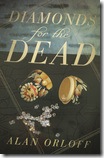
DIAMONDS 72 Alan Orloff’s debut mystery, DIAMONDS FOR THE DEAD, will be published in April by Midnight Ink. The first in his new series, KILLER ROUTINE – A Last Laff Mystery, featuring Channing Hayes, a stand-up comic with a tragic past, will be out Spring 2011 (also from Midnight Ink). For more info, visit www.alanorloff.com

Rearing Writers

Elizabeth in first grade Surprises are one of the fun things about having kids. You just never know what they’re going to do next.

And you sure as heck don’t know what they’re going to grow up to be. One day you’ve got a budding veterinarian on your hand, then next day a corporate lawyer.

I’d never dream of pushing my children to follow in my footsteps—whatever they want to be works great, as long as it takes them on a voyage of discovery.

But there are some basics I expect from them. :)

My friends have always been amazed that I can “get my children to tell me about their day.” This isn’t that much of a trick….I started early and I framed the telling of my day like a story. Now they tell me about their day in storytelling format—some days it’s a funny story, some days it’s a stressful story.

I want them to be able to discuss with me, in a fun way, books they’ve read—the good parts and the bad parts and the times they felt like the author really got off-track.

I want them to be competent writers, even if they never want to become a professional writer.

Here are some things I’ve done to encourage my children to be better writers (and readers. But reading and writing can go hand in hand.)

  • I tell them stories about their life (the day they were born is always a popular one.)
  • I tell them stories about my life and about their dad’s life, too (because he’s not a writer, but I know his stories well enough to tell them in an entertaining way). They love to hear stories about our lives when we were their age.
  • I make up stories at bedtime. My turning-13 year old son doesn’t hear as many of these anymore, but I tell my daughter a made-up story every night.
  • I read to, with, and in front of my children.
  • I spend time looking for books that suit their age and interests for them to read.
  • I tell them about my favorite books when I was a kid. Sometimes we read them together.
  • I share some of my writing with them and answer their questions about how it gets from my laptop to a bookstore.
  • I’m not critical about grammar or spelling errors when they write for fun.
  • I speak to their classes about writing, if the teacher asks me.

Kids are naturally gifted with creativity and it’s so rewarding to see it just bubbling out of them. There’s nothing better, for me, than to have my son ask me why I think a particular author’s recent release wasn’t as good as his others (looked to be rushed out 6 months after the previous book’s release) or to have my daughter ask if I would look at her new story.

They may never become authors, but I know they’ll always love books and know a little bit about what goes into making them.

Do you personally know any budding writers…kids or adults?

It’s Thursday morning—and I’m cooking up po’boys at the Mystery Lovers’ Kitchen. And just about setting my house on fire in the process…

Scroll to top