Consciously Making Writing Goals

soccer_04My writing friend, Jan Morrison, had a great post on Thursday about the book The Kaizen Way by Robert Maurer.

Jan explains that Maurer’s approach to life involves asking ourselves small questions to move forward toward goals. Jan said that by posing small questions to ourselves we don’t freak ourselves out by goal-planning and subconsciously sabotage our efforts.

I like this idea a lot because while I’m a huge list-maker and goal-planner, the thought of the Big Picture of the next 20 years of my writing life tends to freak me out a little. If you were to ask me, off the cuff, where I’d like to be with my writing 20 years from now, for example, I’d probably be so overwhelmed that I wouldn’t even know how to answer the question.

In fact, my agent asked me a similar question about a year ago (we were having a coffee together at a conference) and I looked at her like she’d grown horns.

Sometimes I feel like I can’t see the forest for the trees—I’m just so darned busy. I’m working toward the next deadline at all times.

What my agent’s question forced me to do last year, though, was to actually pull myself out of my minute to minute scrambling and think about the big picture. It still freaks me out, though. My answer to my agent’s question, at the time, was to say that I wanted to keep doing what I was doing right now. That I was interested in exploring other genres and ideas….later on. I was very vague about it all.

Jan posted her list of small questions to herself on her blog post. She gives some good direction on how to start thinking about goals for life and writing. And asking myself questions is a much nicer way to approach goal-setting than making a bulleted list.

I also like the idea of breaking down goals (once I’ve identified them) into small steps…it makes it so much easier to reach a goal.

Have you set goals for yourself, as a writer?

An Original Story

blog10I just finished reading a very disturbing book all the way from cover to cover—so you know it must be book club time for me. :)

Ordinarily, I wouldn’t pick a story to read that gives me nightmares at night, but my book club seems to have a proclivity for picking them.

I was reading the harrowing and unusual tale with great trepidation when I suddenly came across some story elements so familiar to me that they comforted me—and it all started with a crazy wife locked in a remote section of a large house. Jane Eyre! I thought with relief, and was able to keep reading the book club selection. Sure enough, the story was on a real Gothic kick from that point on.

I’ll sometimes hear writers worry about writing a really original, breakout story.

But I really don’t think there are any really original breakout stories to be written. I think that each of us has the opportunity to do a really bang-up job on an old story in our unique voice.

It’s been said that there are only seven basic plots in all of literature. Actually, there have been said to be several different numbers of basic plots, but seven is the number mentioned most frequently.

This site lists 1 basic plot, 7 , 20, and finally, 36 basic plots.

What if there are as many as 36 basic plots in literature? That’s still not many.

And yet, with all the similarity in theme, we’re not getting bored with books. Or movies, because films are limited to these plot lines, too.

That’s because each writer brings something of themselves to the book. It could be an amazing character they created or a fabulous setting. It could be the writer’s voice in the way he tells the story.

Just the fact that the writers are all different means that their stories will be unique. Their takes on the stories will be unique. Out of the 36 plots, one writer might use a particular plot in a thriller and another might use it in a romance.

It’s our different takes on life that make plots unique.

Do you ever notice this repetition of plots in books and movies? Most of the time, I’ll admit, I don’t…each story seems very different.

Staying Motivated by Starting Out the Day With a Win

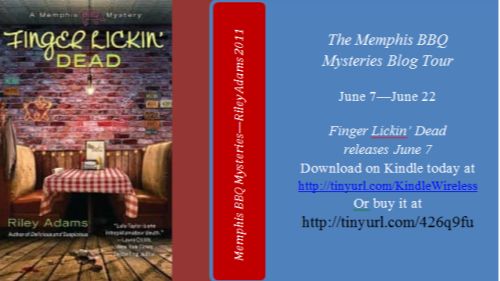
blog9Lately, looking at my to-do list, I’ve felt pretty snowed. I’ve got Finger Lickin’ Dead releasing June 7th, a book due July 1, and a complete outline for another book due August 1.

And the children are almost out of school for the summer. :)

I’m good at prioritizing the things I need to do, but when everything is a priority, it makes it tough.

What I’ve found keeps me knocking through the items on my to-do list, is a couple of different approaches.

Some days I’ll put several quick and easy tasks on my to-do list—stuff that I need to do, but that only take a second. So my list could have these things on it: 1) Put sunflower seed in the birdfeeder 2) Water potted plants on front porch 3) Put newspapers in recycling bin

Honestly, I feel so smug after crossing three things off on my list, that I start attacking the rest of the to-do list with renewed vigor. Sad, but true.

My other approach is to put the most loathed, procrastinated task on the top of my to-do list. Then, the whole rest of the day, I’m proud of myself for knocking it out. It gives me more motivation to keep crossing things off my list.

I’m a productivity nut, so please share how you stay motivated and don’t get overwhelmed by your to-do lists. Inquiring minds want to know!

*************

Sign up for the free, monthly Writer’s Knowledge Base newsletter for writing tips and resources and to be entered in our first giveaway. Details here.


Finger Lickin’ Dead launches June 7th

Giving Characters a Chance to Grow

In the book I’ve just finished writing, my protagonist is a successful, self-assured, retired museum curator. She’s moved to a small Southern town to be near her daughter and get a break from the hectic pace of her life.

Of course, things don’t go all that smoothly for my character. Besides getting mixed up in a murder investigation (the main plot), she’s also faced with a number of challenges on a smaller scale—everything from dealing with the change of pace, to learning quilting (something she’d had no plans of ever learning.) My protagonist is pushed from her comfort zone at every opportunity.

Looking for the perfect way to challenge your character? Ask yourself how they view themselves. What do they think they’re good at? What do they find personally challenging?

Why we should play to a character’s weaknesses instead of their strengths:

It gives them the opportunity to fail. Who likes perfect characters?

It gives them the opportunity to try again. And persistence is a likeable trait.

It provides additional conflict for your book. Sure we’ve got the main plot and all the conflict that goes with it. But extra conflict adds tension to a book and makes for an interesting subplot that can motivate the reader to keep reading to see how the character deals with it.

It gives them an opportunity to ultimately succeed. Because we all like to see hard work rewarded.

Have you given your characters a chance to grow lately?

Quick Tip for Character Development

Seeing Creative BlogIn my blog reading last week, I came across an interesting post on the Seeing Creative blog.

Sometimes I think stereotypes are nice for writers.  I know that sounds odd to say, but if you’re writing a minor character–if you have your stock nerd, jock, prom queen, etc., the reader instantly gets the character. There’s not a lot of work needed there. It’s easy.  And it’s easy for the reader, too—particularly if they’re trying to get acquainted with all the other characters (the important characters) in your book.

But stock characters won’t work for a protagonist or other characters with large roles.  Obviously, if our books are overflowing with stereotypes,  we haven’t done our jobs as writers.

A cool way to shake up stereotypes and help create unique characters was mentioned in the post “Creating the Non-Stereotypical Character.” Stina Lindenblatt said that author Mary Buckham recently conducted a workshop through her local RWA chapter.  In the workshop, she had the writer either pick the occupation or hobby/interest of the main characters in their novel,  then list 5 character traits associated with those careers.  Ms. Buckham then had the author switch the traits around.  You can see some results here

Another good way to create unique character is by blending the traits of several different strong personalities of people you know. 

How do you keep your characters unique?  Do you sometimes use stock characters for minor roles in your book?

Scroll to top