Another Reason Experience is Important for Writers

by Elizabeth S. Craig, @elizabethscraig

file9001259016672I spent the other morning at the DMV. The DMV, for my non-US readers, is the Department of Motor Vehicles. It’s one of those dreaded places here in the States—full of high counters and long lines.

My son was with me to get his driving permit. We’d arrived 45 minutes before the office opened and were already 5th in line. By the time it opened, the line wrapped around the corner of the squatty government building. It was freezing outside—a shock after such a balmy winte–and my son and I were moving around, swinging our arms, as we waited. His bouncing was probably nerves and mine was a futile attempt to keep warm.

We finally navigated through the different stations after a bad moment where we’d sat in “the wrong set of chairs” for what we were in line for. The DMV has always reminded me a little of Dickens’ Circumlocution Office. We quickly sat in the right set of chairs and my son took his test.

And, thankfully, passed it. But he wasn’t completely satisfied because he’d missed several questions and he’s a typical Type-A firstborn.

“Mom, I missed the stupidest questions!”

“I’m sure they weren’t stupid.”

“They were. One of them asked when roads are the slickest. I chose ‘after three hours of raining’ because of all the cars that hydroplane—the roads have got to be really slick then. But they said the right answer was ‘within the first 15 minutes of raining’,” he said.

“Ohh. Well, yes. They’re right. That’s because the oil rises up to the road surface and you skid on all the old oil puddles on the road,” I explained.

This didn’t cheer him up. “See! Even you knew it and you haven’t even studied the book.”

“But I’ve been driving for 26 years. I know it completely through experience.”

I think that’s one thing that sometimes gets missed when writers recommend frequent writing as a way to improve. What tends to get mentioned is the skill you acquire.

What I think practice and experience gets you are personal strategies for advancing a story and the confidence to complete one.

If you hit a roadblock, you’ll know the best way for you to handle it. For me, that means marking the scene with asterisks and coming back to it later.

You’ll know what to do when you’re stuck on a scene and you aren’t in the right mind-frame to write it. For me, this means skipping the scene and writing another one that’s better suited to my mood.

You’ll find the easiest method for you, yourself, to write a book…you’ll learn if you should outline, wing it, write in the mornings, write in the evenings, write during your commute. You’ll learn shortcuts, your strengths and your weaknesses. You’ll learn how to keep yourself motivated.

You’ll gain confidence that you can finish a book, submit it, and stomach the reviews, good or bad.

Experience is the only way to figure out what works best for us. It’s the only way to know how to make it through the obstacle course that each book presents. It’s the only way to deal with the end result of being published and having that book in the hands of the readers.

You can read manuals on driving and manuals on writing. But experience counts more. (And, I’d add, experience reading the genre that you write.)

It’s true that our writing improves each time we sit down to write and with each book that we finish. I know my books have stronger verbs, better dialogue, rounder characters, and more literary elements than they did when I started out.

That improvement is more intangible and murky, though, unless it’s directly compared side by side with other examples of my writing. What motivates me, usually, are tangible results. Motivation is a stack of finished books and my level of confidence— things I can easily see, easily feel.

It’s the knowledge of what to do at an intersection full of oil slicks when it starts to rain.

What does your regular writing habit help you gain?

Constructing and Weaving in Subplots

by Elizabeth S. Craig, @elizabethscraigfile2501247069216 (1)

My last post was about my layering approach to writing books, and I got a question from a blog reader about how to create subplots and then how to weave the subplot layer into a finished draft.

Subplots are sometimes my favorite part of a book. In fact, occasionally the main plot of a novel will leave me cold as a reader and I’ll flip ahead in the book just to find out how the subplot ends up.

My subplots are almost always humor-based and end up tying into the book’s ending. Your subplot could involve a budding romance, or the protagonist’s teenager’s gradual descent into drug use…really, any plot smaller than the main one that can enhance the main plot (through conflict or character development or by adding complications) in some way.

*****Since I don’t like to write spoilers for anyone else’s books, I’ll do a couple for mine (in books that are older releases) as examples… they’re minor spoilers. But heads up if you’re one of my readers!*****

What I do is come up with complete, small episodes…almost short stories. Then I create scenes with each installment of the subplot story, to create what will end up being a running serial throughout the main plot. For me, it could even be on the level of a running joke that suddenly has more significance at the end of the book.

Most of my books have more than one subplot. The subplots vary in length and complexity. I’ll use two for examples…a very short one and a longer one.

One of my subplots involved two men who were friends with each other and also friends with my sleuth. One of the men was bragging about a prized bottle of expensive and rare wine that he’d acquired. The other man kept dropping hints or outright begging to come over and share a glass of this wine. He found opportunities to celebrate and eagerly asked his friend if he’d open the bottle. But the friend always refused.

I started this subplot fairly early in the book—and dropped in the dialogue mentioning it following a regular scene in the book. So I had a first mention of the subplot with the man bragging about the wine. Then I continued with it at intervals throughout the story….again, each mention was like a mini-episode or the next installment of the mini-serial. So I wrote in a couple of other mentions, escalating the friend’s frustration and his requests to participate in a wine tasting.

Then, at the end of the book, I had the friend completely give up on the chance that he’d ever sample the wine. He decides to go to the wine store and purchase a bottle himself. On the way back with the wine, he comes across the sleuth in a perilous situation near the wine store, and drops the bottle to come to her aid.

This is really, the briefest of subplots. It adds a little humor to the story when things get serious with the murders. It gives the opportunity for bits of character development as my protagonist reacts to the friends’ battle over the wine. It gives a change of pace. And then the subplot makes a surprise appearance again at the end of the story and lends a feeling of continuity and completion at the finish.

Another subplot I wrote into a different series was a little longer and a bit more involved. My protagonist for that series, Myrtle, is a crotchety elderly woman who has a reputation for being prickly. A feral cat takes up with her and she genuinely becomes charmed with it…although the cat attacks visitors to her home. She admires its toughness.

Again, I wrote the subplot straight through on a separate document—the whole story of the subplot in episodes. Then I wove those little episodic scenes into the main plot and tied it into the ending.

Throughout the story the subplot developed: Myrtle becomes acquainted with the cat, the cat acts out with various visitors to the home. The cat develops a true fondness for Myrtle and decides to bring her gifts—sometimes gifts that aren’t dead. Myrtle receives bunnies and other creatures from her determined cat friend. I interspersed these episodes throughout the book. This particular subplot helped develop Myrtle as a character—and showed another, softer, side to her.

At the end, when Myrtle is confronted by the killer, a separate subplot comes back into play (Myrtle’s horrible cooking that plagues the series) which leads into the cat’s intrusion during Myrtle’s confrontation with the murderer….which creates enough of a distraction for Myrtle to take control of the situation.

So….that’s it in a nutshell. I do want my subplots to end up impacting the main plot, develop my characters a bit, and relieve tension in my books. I write them as complete stories, then chop them up into scenes and intersperse them through the main story. Then I tie the subplot into the ending of my book (which also helps me with writing endings…never my favorite thing to write.)

Hope this helps instead of being completely confusing. Now it’s your turn—how do you write in subplot layers to your book? I’d love to hear some other ideas (especially since, when I find something that works for me, I stop thinking of other approaches!)

Lists and Layers

by Elizabeth S. Craig, @elizabethscraig

file3731303823442Recently I was at an event where I spoke with aspiring authors after my talk.

They asked about the number of books I’d written, then they looked both amazed and discouraged at the same time. “How do you get through a book? There’s just so much to think about when you’re writing.”

I told them that I try not to think about the big picture (plowing through 275 pages, editing it, submitting it to my editor, and worried waiting for reviews) as much as possible. It just makes me feel overwhelmed. If I approach the book as simply advancing the story a day at a time (with an idea of where I’m heading and keeping in mind what readers might enjoy most), then it seems like a much smaller project.

Another trick is that I’m not trying to keep everything in mind as I’m writing a book (except reader enjoyment.) I love reading books about writing, magazine articles on writing, and blog posts on writing, but I can’t focus on character arc, story structure, engaging descriptions, and all the other elements that these resources recommend for a good story.

I use layering and lists as tools to make sure I round out my story later. I write my books straight through (without pausing for chapter breaks) and end up with about 55,000 words. This is the bare-bones story. Then I start layering in other elements. This is what I’m doing right now to put the finishing touches on a book I’m turning in at the end of this month.

Layers

Parts of the book that I add in layers for 2nd and 3rd drafts:

  • Setting descriptions
  • Character descriptions
  • Character last names and place names (I’ll mark as *** on the draft so I can find my spots later.)
  • Any scenes I was stuck on. I just make a couple of notes about what I wanted to accomplish with the scene and move on to the next scene.
  • Subplots can be included perfectly as a separate layer. In fact, it’s almost easier that way because you can just gradually weave them in to the story that’s already on the page.

I do the same thing with revising. If you think to yourself that you’re editing a whole book, the thought of it can be just as overwhelming as writing the book was.

These are issues that I address in layers for the revision (and for a longer list of things I look for during revision, click this post)

  • Typos/grammar
  • Crutch words that I use too frequently
  • Conflict—I make a pass through to make sure each scene either forwards the plot or adds to the conflict
  • Continuity (is the character wearing the same outfit on page 20 that she’s wearing on page 21?)
  • Subplots—did they resolve? Did they tie into the main plot?
  • Loose ends—is everything resolved at the end of the book?

Lists

Somehow, it’s easier for me to come up with lots of different ideas if I make them into bullet points and put them in list form. These lists could include:

My protagonist’s catch-phrases.
My protagonist’s features. Different physical traits of my protagonist.
My protagonist’s facial expressions.
*5 possible endings for this book.
*5 twists.
*5 possible subplots.
*5 ways the subplots could tie into the main plot.
Or you could do it for character growth:
*5 ways the character could grow.
*5 surprising things that we could learn about a character.
*Top 10 list of things that bother the protagonist (then 10 things that would drive the character crazy that I could write into the book.)
*10 things this character loves more than anything.
You could find other uses for lists, too:
*5 ways to add some unexpected elements to the book (humor, suspense, sadness, fear.)
*5 ways to describe the setting.

The best results are woven into the story or used to inspire dialogue that develops my characters more.

These are the tools I use for every book to make sure that I keep things fresh and keep from feeling overwhelmed. How do you keep focused and keep moving ahead with your story?

Twitterific

by Elizabeth S. Craig, @elizabethscraig

twitter_newbird_boxed_blueonwhiteAll the links below, and over 15,000 others are found in the Writer’s Knowledge Base search engine—where you can search on any topic for free. Like us on Facebook or sign up for our free monthly newsletter for the web’s best links on writing.

Don’t’ forget the new release blogfest that Hart Johnson and I are hosting on June 5th—find more information and sign up here. The best entries get signed copies of our new releases!

And best wishes for a Happy Easter or Passover to all who celebrate.

5 Ways to Get Past Writer’s Block: http://bit.ly/Huvrsk @fictionnotes

Fight scene basics: http://bit.ly/HuvSTs @jamesagard

You’re agented? Cool! But can she sell you? http://bit.ly/Hadtg9 @behlerpublish

PublishAmerica, Literary Agent: An Inside Look: http://bit.ly/H4IDHa @victoriastrauss

5 Ways to Liven Up a Description: http://bit.ly/H4IH9Y @DiYMfa

Making Platform our Art: http://bit.ly/H4IYcV @KristenLambTX

How Screenplay Structure Can Help Plotting & Pace In Your Novels: http://bit.ly/H4J6cp @BryanThomasS

Taking the Mystery Out of Writing Mysteries: http://bit.ly/H4Jc3K @DPLyleMD

Trust your instincts: http://bit.ly/H4JkQT @anna_elliott

Is creativity going the way of the collective? http://bit.ly/HxI34t @creativitypost

6 Benefits of Blogging: http://bit.ly/HxIuM8 @LyndaRYoung

Advice for writers on GoodReads: http://bit.ly/H3KAEJ @WriterCrys

4 tips for writing humor: http://bit.ly/H3J2ux @write_practice

Character Development Questions: http://bit.ly/HxJjom @HeatherMcCorkle

The Rise of Indie Authors and How This Helps Publishing: http://bit.ly/HxJos9 @thecreativepenn

Startup Costs Of Freelancing: http://bit.ly/HxJwb6 @writertank

5 Tricks To Adapting A Well Known Story For Fiction: http://bit.ly/Hr4p8w @BryanThomasS

3 Writing “Cheats” for Making Dialogue Work Harder & Ring True: http://bit.ly/Hr4Dg7 @MuseInks

A TV Guide Approach to Hooking Your Reader: http://bit.ly/H2zFFY @writerashley

Turning your ebook into a free ad: http://bit.ly/H86irr @curiosityquills

When Characters Change (or Don’t): http://bit.ly/H86ruX @beth_barany

Read Your Way to Better Writing: http://bit.ly/H86xTi @writeitsideways

Should You Write the Whole Trilogy Before You Query? http://bit.ly/H86Cq1 @Janice_Hardy

An Agent Defines “Unsolicited Manuscripts”: http://bit.ly/H86Ld3 @bookendsjessica

What If Our Story Idea Has Already Been Done? http://bit.ly/H86RBo @JamiGold

Precise story summaries are key to queries: http://bit.ly/H86Xcr @greyhausagency

How to do Social Media Right: http://bit.ly/H870F1 @AskATechTeacher

A helpful look at the WordPress dashboard: http://bit.ly/H874ol @jhansenwrites

Why We Need to Put Our Books to Bed: http://bit.ly/H878Eq @jodyhedlund

Goodreads’ guide to dystopian novels (infographic): http://bit.ly/H87lHD

Outside the box marketing: http://bit.ly/H87qLH

The Next Self-Publishing Frontier: E-Books In Translation: http://bit.ly/HEPvbu @laurahazardowen

The Write It Forward Author Marketing Plan: http://bit.ly/HEPYKY @jentalty

The New iPad Reviewed For Authors: http://bit.ly/HEQgkY

Making Sure Your Agent Can Sell You – Part 2: Description vs. Specifics: http://bit.ly/HEQybB @behlerpublish

Symbols in The Hunger Games: (series spoilers): http://bit.ly/HEQSae @tordotcom

How Honesty Compels Readers to Comment: http://bit.ly/HER0GA @problogger

The Marketing Paradox: Start Small to Get Big: http://bit.ly/HERQmS @janefriedman

That Final Manuscript Cleanup: http://bit.ly/HaPlIm @noveleditor

Narrative, Plot, and Story: http://bit.ly/HaPmMm @writing_tips

Scene endings and sub-genres: http://bit.ly/HaPv2v

The Potential of Social Media in Driving Book Sales: http://bit.ly/HQkzmw @digibookworld

What Authors and Publishers Can Learn from the Hunger Games Marketing Campaign, Part 2: http://bit.ly/HQkSOo @syntactics

A Dialogue Comparison of Twilight and Harry Potter: http://bit.ly/HQmdEO

Moving Beyond Self-Publishing: How are Locke, Hocking, and James selling? http://bit.ly/HFBNGD @PublishersWkly

PublishAmerica, Literary Agent: An Inside Look: http://bit.ly/H4IDHa @victoriastrauss

Tips for a non-fiction proposal: http://bit.ly/HRaO7I @nicolamorgan

Thoughts on being a hybrid author: http://bit.ly/HRb8U2 @KristenLambTX

Writer @ChuckWendig on rejection: http://bit.ly/HRbAS4

Recommending Books for the Characters of “Mad Men:” http://bit.ly/HRbJVC @bookriot

A Reader’s Drinking Game, First Edition: http://bit.ly/HRbTMF @NewDorkReview

6 Tips For Hiring The Right Freelance Editor: http://bit.ly/HRcy0D @meghancward

Does Your Character Wear Purple Converses? http://bit.ly/HRcHkJ

Humor Writing for People Who Aren’t Funny: http://bit.ly/HRcNcg @jeffgoins for @write_practice

12 Steps to Blog Tour Success: http://bit.ly/HRcSN4

Creative Writing Prompts: Secrets and Lies for Your Characters: http://bit.ly/HRcZYY @howtowriteshop

Believing We Have a Story to Tell: http://bit.ly/HRdjad @AReasonToWrite

Tips on Showing Character Motivations: http://bit.ly/HRdmmk @Janice_Hardy

Worldbuilding–measurements: http://bit.ly/HH1jdu @JulietteWade

How writers can flourish when confronted with story restrictions: http://bit.ly/HH1Dsx @storyfix

Freelancer Advice from NYT Magazine Culture Editor: http://bit.ly/HH1Snu @jasonboog

Traditional Publishing: The Query And The Funnel: http://bit.ly/HH1ZPV @thecreativepenn

60 Synonyms for “Trip”: http://bit.ly/HH2cCK @writing_tips

Patient Sues Doctor for Using Her in a Book: http://bit.ly/HH2h9B @passivevoiceblg

How Much Should You Write Every Day? http://bit.ly/HKGq0O

Does comedy have to be cruel? http://bit.ly/HKGBJz @salon

Elements of Fantasy: Brownies: http://bit.ly/HKGD4i @fantasyfaction

Why The Hunger Games Is the Future of Writing: http://bit.ly/HKGL3I @jeffgoins

11 things to know about blogging: http://bit.ly/HKHxO9 @victoriamixon

Finding the Story in Nonfiction: http://bit.ly/HKHHoI

Tips for Writing the Small Town Romance: http://bit.ly/HKHNwC @ktlane3

A tip for making a living as a writer: http://bit.ly/HKHS3n @rachellegardner

Amazon’s Author Central: Keeping Track of Your Books: http://bit.ly/HKHZvO @fictionnotes

Story Structure–Inciting Event and Key Event: http://bit.ly/HKI0Qj @KMWeiland

How Writing against the Grain Creates a Niche: http://bit.ly/HKI82l @hopeclark

The Writing Life: The Value of Tenacity: http://bit.ly/HKIciv

Quirks and legs matter more than talent and perfection: http://bit.ly/HKIeHh @speechwriterguy

Feeling stuck? 7 “block” busters for writers: http://bit.ly/HKIl5H @RuthHarrisBooks for @annerallen

Writing Tips: Guns, Bullets And Shooting: http://bit.ly/HKIqX2 @dsawyer for @thecreativepenn

The Chicago Manual of Style isn’t the only guide, reminds one editor: http://bit.ly/HKIwhl

Steps to take when preparing to write a novel: http://bit.ly/HKINRk @lisagailgreen

Trends in Publishing: Android Apps for Writing: http://bit.ly/HKIOEW @chicklitgurrl

Give Your Writing A Case of Spring Fever: http://bit.ly/HKIXrS @serbaughman for @writeitsideways

Basic Plot Brainstorming: http://bit.ly/HKJ1ba @eMergentPublish

Persistence Often Leads to Publication: http://bit.ly/HKJ2vT @livewritethrive

Why 1 Writer is Considering Deleting Her Facebook Account: http://bit.ly/HKJ9aP @janice_hardy

The use of gossip and rumors in crime fiction: http://bit.ly/HhJfZ4 @mkinberg

When worldbuilding becomes too much: http://bit.ly/HhK4kF @greyhausagency

5 blogging lessons inspired by parenting: http://bit.ly/HhKaZk @rzive

Celebrating the Complicated Girl: http://bit.ly/HhKjMz @yahighway

10 tips for conferences: http://bit.ly/HhKAyU @msheatherwebb

Scrap”irregardless”: http://bit.ly/HhKDe2 @howtowriteshop

5 SEO Blog Tips to Increase Traffic to Your Site: http://bit.ly/HhMG1W @karencv

3 Pieces of Advice For Aspiring Authors: http://bit.ly/HhMRtV @ChuckSambuchino

Tips for ending chapters: http://bit.ly/HhMYFV @Kid_Lit

The Seattle Times–no fan of Amazon: http://bit.ly/HhOeZE @Porter_Anderson @LauraHazardOwen

Writers–self-pub moonlighting is serious business: http://bit.ly/HZSqhL @Porter_Anderson @CFSaller @jamesscottbell

Completion, and Resonance: why the first chapter is like the last: http://bit.ly/Hruwqb @juliettewade

3 ideas for developing voice: http://bit.ly/HruGOc @KristenLambTX

Farther vs. Further: http://bit.ly/HruM8A @writing_tips

13 Ways to Develop a Story That’s Too Short: http://bit.ly/HruQoF

Life is Short. Read with Purpose. http://bit.ly/Hrv0MU @diymfa

Story structure tips: http://bit.ly/Hrv53j

Story endings and resolution of conflicts: http://bit.ly/HrvaDW

How To Pitch Your Book to Online Outlets: http://bit.ly/Hrvhzo @galleycat

Simple tips for keeping a journal: http://bit.ly/HrwLd7

Training The Writer: http://bit.ly/HrwS8z @sarahahoyt

Do-It-Yourself Publishing: http://bit.ly/HrxpqX @passivevoiceblg @Occupy_Pub

5 Ways to Get Your Book into Bookstores: http://bit.ly/HqoASf @jkairys for @JFBookman

Defining literary fiction: http://bit.ly/HqoJoH @janefriedman @sanjidaoconnell

7 Dialog Basics That Can Help Tighten Our Stories: http://bit.ly/HqoLgz @jodyhedlund

You Must Engage Your Creative Side: http://bit.ly/HqoSsi @jeffgoins

7 deadly sins: http://bit.ly/HqoTwv

Keep Your Characters True To Themselves: http://bit.ly/Hqp231 @SharlaWrites

The Dos and Don’ts of Novel Endings: http://bit.ly/Hqp3Uz @writersdigest

10 Blogging Fears Worth Chasing Down: http://bit.ly/Hqp8HZ @catseyewriter

Selling Ebooks Direct: How To Set Up A Simple E-Bookstore: http://bit.ly/HqpbDF @DavidGaughran

Who to Trust When Writing Your Book? http://bit.ly/Hqpjmt @originalimpulse

Writing lessons learned from Heist Society: http://bit.ly/Hqpoqg @juliemusil

When query letters mention professional editing: http://bit.ly/Hqprm7 @behlerpublish

Microsoft OneNote – An Author’s Best Friend: http://bit.ly/HqpwWT @selfpubreview

Twitter Tips: How to Keep Your Followers: http://bit.ly/Id1Jce @AnnieNeugebauer

The Power Of Diligence: http://bit.ly/Id1VbI @BryanThomasS

7 Blogging Mistakes Authors Make: http://bit.ly/HlZQuM @goblinwriter

8 Reasons Your Story Might Not Be Selling: http://bit.ly/HPHQXZ

1 writer’s typical process for writing a chapter: http://bit.ly/Hm06Kf @fictionnotes

2 Tips to Accelerate Completion of Your Writing Projects: http://bit.ly/Hm0dWf

Use music as motivation to write: http://bit.ly/Hm0k40 @byrozmorris @jamesscottbell

How to start a blog: http://bit.ly/Hm0p7S @woodwardkaren

Top tips for cozy mystery writing: http://bit.ly/Hm0tEB

Story structure–the reversal: http://bit.ly/Ho03zx @Mommy_Authors

Is your book a Fence-Sitter? Consider finishing your book! http://bit.ly/Ho0g5I @behlerpublish

6 Core Storytelling Competencies: Good… Better… Best. http://bit.ly/Ho0oC5 @storyfix

How to successfully launch a YA print novel: http://bit.ly/Ho0OZk @laurapauling

Top Tips for Cozy Mystery Writing and a Crazy Cozy Blogfest

by Elizabeth S. Craig, @elizabethscraig

Crazy_Cozy_Blogfest_v1-2_400pxToday I thought I’d move into mystery writing territory for a while and include some of my top tips for cozy mystery writing (some of which will work well with other types of mysteries.)

Today’s post comes a little less than two months before the release of a new cozy series for me and the debut of a new cozy series from my friend Hart Johnson. We thought we’d band together and make a fun blog hop on June 5th) to celebrate our releases and host a giveaway. More information is at the bottom of the post.

What’s a cozy mystery? Cozies, sometimes called traditional mysteries, are a subgenre in a large field of mystery subgenres. They’re primarily defined by their use of an amateur sleuth, lack of gore and profanity, offstage murder, and focus on the whodunit puzzle. These mysteries are frequently (not always) humorous, character-focused, set in small-towns, and are part of a series.

Tips for cozy writing:

The sleuth will be a gifted amateur, but you’ll want to have a police source. Make sure your sleuth has access to some of the same information that the police has—time of death and the potential weapon, for example.

Make sure you’re leaving several clues to the murderer’s identity, but aren’t making them too obvious. The clues need to be scattered throughout the book, but the reader doesn’t need the equivalent of a neon sign pointing out that a clue happened. Find a way to lay the clue but to distract attention from it—maybe another suspect arriving on stage? A sudden argument between the sleuth and another character? Something that seems like a more important clue?

Give the reader a reason to care about the case. Is the victim someone very likeable and innocent and they want to avenge her death? Is one of the suspects wrongly accused and needs to be vindicated? Is the sleuth somehow personally involved or emotionally connected to the case?

Be careful with your number of suspects. Suspect numbers can get a little tricky. You want enough suspects to ensure that the killer’s identity is a surprise, but not so many that the reader forgets who they are. I usually like five suspects, killing one in the middle of the book. One of my editors actually prefers fewer.

Have suspects tell both lies and truths. The sleuth and reader will try to discern which is which. If everyone has something to hide or someone to protect, it creates a lot more conflict in the story.

Consider eliminating the most promising suspect. It can shake up a story in the middle of a book.

Crazy Cozy Blogfest

Now, to help Hart and me with our upcoming releases (and have the chance to win signed books) you can create your own cozy mystery. Except it will be a lot shorter and you don’t have to use any of the tips I included above. :)

Sign up with the Linky tool below, adding your blog to our list of June 5th participants.

Include:
1) Sleuth (age, occupation, maybe a little family info)
2) Sidekick (either friend or foil, but someone who always seems to be around)
3) Setting (town, city, or other sort of place)
4) Theme (go nuts)
5) Twist (be as creative as you like)

Write it up in 150-250 words (keeping things short for the blog hop).
Please include either our book descriptions or a promo mention or a link to our sites or for buying books.

Click
here to enter

This list will close in 61 days, 3 hrs, 54 min (6/5/2012 11:59 PM CST

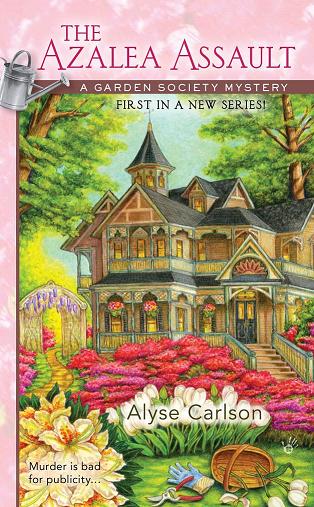
The Azalea Assault
Cam Harris loves her job as public relations manager for the Roanoke Garden Society. It allows her to combine her three loves, spinning the press, showing off her favorite town, and promoting her favorite activity. She’s just achieved a huge coup by enlisting Garden Delights, the country’s premiere gardening magazine, to feature the exquisite garden of RGS founder, Neil Patrick. She’s even managed to enlist world-famous photographer Jean-Jacques Georges. Unfortunately, Jean-Jacques is a first-rate cad—insulting the RGS members and gardening, goosing every woman in the room, and drinking like a lush. It is hardly a surprise when he turns up dead. But when Cam’s brother-in-law is accused and her sister begs her to solve the crime, that is when things really get prickly.

Alyse Carlson: Alyse Carlson is the pen name for Hart Johnson who writes books from her bathtub. By day she is an academic researcher at a large Midwestern university. She lives with her husband, two teenage children and two fur balls. The dust bunnies don’t count. This will be her first published book.

Links:
Amazon
Barnes and Noble
Indie Bound
Confessions of a Watery Tart

Prizes: Hart/Alyse and I will pick our our favorite entries and both winners will get signed copies of both books.


Please help us promote the blogfest by taking the button and banner (thanks to artist
Joris Ammerlaan for the buttons) and/or share the Linky Tool below for the blog hop.

Quilt or Innocence
Beatrice has a lot of gossip to catch up on—especially with the Patchwork Cottage quilt shop about to close. It seems that Judith, the landlord everyone loves to hate, wants to raise the rent, despite being a quilter herself… But when Judith is found dead, the harmless gossip becomes an intricate patchwork of mischievous motives. And it’s up to Beatrice’s expert eye to decipher the pattern and catch the killer, before her life gets sewn up for good.

Elizabeth Spann Craig: Elizabeth writes the Memphis Barbeque series for Penguin/Berkley (as Riley Adams), the Southern Quilting mysteries (2012) for Penguin/NAL, and the Myrtle Clover series for Midnight Ink. She blogs daily at Mystery Writing is Murder, which was named by Writer’s Digest as one of the 101 Best Websites for Writers for 2010, 2011, 2011.

Links:
Amazon
Barnes and Noble
Indie Bound
Mystery Writing is Murder

Thanks, everybody!

Scroll to top